
Budget 2026–27: A Comprehensive Development Blueprint Inspired by Three Duties
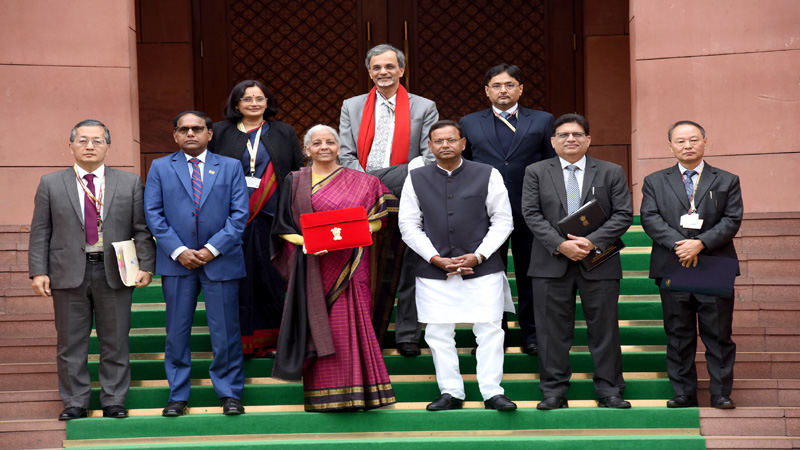
New Delhi: Presenting the Union Budget for 2026–27 in Parliament, Union Minister for Finance and Corporate Affairs Smt. Nirmala Sitharaman described it as being guided by “three duties.” Prepared at Kartavya Bhavan, this is the first budget to embody a holistic vision that accelerates economic momentum, fulfills public aspirations, and ensures equitable access to resources for all.
The Foundation: Three Duties
To keep economic growth fast and stable amid global uncertainties by enhancing productivity and competitiveness.
To fulfill people’s aspirations and make them active partners in India’s prosperity.
To ensure access to resources and opportunities for every family, community, and region in line with the vision of Sabka Saath, Sabka Vikas.
Key Budget Estimates
Non-debt receipts: ₹36.5 lakh crore
Total expenditure: ₹53.5 lakh crore
Net tax receipts: ₹28.7 lakh crore
Fiscal deficit: 4.3% of GDP
Debt–GDP ratio: 55.6%
First Duty: Accelerating Economic Growth
Manufacturing and Frontier Sectors
Biopharma Shakti: ₹10,000 crore to position India as a global biopharma hub, including new NIPERs and 1,000 clinical trial sites.
Semiconductor Mission 2.0 and ₹40,000 crore for electronics manufacturing.
Rare earth corridors in Odisha, Kerala, Andhra Pradesh, and Tamil Nadu.
Three chemical parks under the ‘Build and Operate’ model.
Capital Goods and Textiles
High-tech tool rooms and a ₹10,000 crore container manufacturing scheme.
National Fibre Mission, mega textile parks, and support for khadi and handloom.
MSMEs and Industrial Clusters
Revival of 200 legacy industrial clusters.
₹10,000 crore SME Growth Fund.
Infrastructure Push
Public capital expenditure of ₹12.2 lakh crore.
New freight corridors, 20 national waterways, and a seaplane VGF scheme.
Seven high-speed rail corridors.
₹20,000 crore for CCUS (Carbon Capture, Utilization and Storage).
Second Duty: Aspirations and Capacity Building
Health, Education, and Skills
Training for 1 lakh Allied Health Professionals and 1.5 lakh caregivers.
Three new All India Institutes of Ayurveda.
20,000 veterinarians.
AVGC content labs in 15,000 schools.
University townships and women’s hostels.
Tourism, Culture, and Sports
Development of 15 archaeological sites as cultural destinations.
Training for 10,000 tourist guides.
Expansion of the Khelo India Mission.
Third Duty: Equitable Access to Resources
Farmers’ Income
Integrated development of 500 reservoirs and Amrit Sarovars; support for fisheries, animal husbandry, and high-value agriculture.
Coconut Development Scheme; branding Indian cashew and cocoa as premium global products by 2030.
Bharat-Vistaar: A multilingual AI-enabled agricultural advisory platform.
Mental Health
Expansion of NIMHANS-2 and upgradation of institutes in Ranchi and Tezpur.
Focus on Purvodaya and the Northeast
Buddhist circuit, e-buses, tourism, and industrial corridors.
Tax Reforms and Ease of Doing Business
Direct Taxes
New Income Tax Act effective from April 1, 2026.
Reduced TCS rates and extended revised return deadline to March 31.
Simplified processes for small taxpayers.
Cooperatives and IT Sector
Tax relief for cooperative institutions.
Safe harbour limit for IT services raised to ₹2,000 crore.
Indirect Taxes and Customs
Relief for seafood, leather, and textile exports.
Duty exemptions on lithium-ion, solar glass, nuclear components, and critical minerals.
Personal import tariff reduced from 20% to 10%.
Customs duty exemption on 17 medicines.
Trade Facilitation
Single digital window, AI-based scanning, and a unified customs platform within two years.
Budget 2026–27 is not merely a financial statement but a comprehensive policy blueprint rooted in three core duties for building a Viksit Bharat. From manufacturing to education, agriculture to infrastructure, and tax reforms to trade facilitation, the budget aims to strengthen the economy, empower society, and ensure balanced regional development simultaneously.