
Ethics in AI Must Be Boundless; Profits Should Align with Purpose: Prime Minister
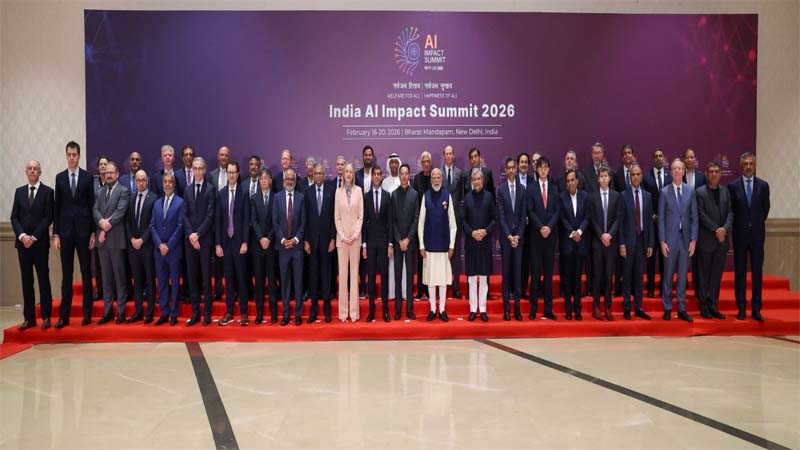
New Delhi: Prime Minister Narendra Modi addressed the leaders’ plenary session at the India AI Impact Summit 2026 held at Bharat Mandapam, expressing confidence that the summit would play a vital role in building a human-centric and compassionate global AI ecosystem. Welcoming participants, he said history shows humanity has always turned disruptions into opportunities, and the present moment offers a chance to transform disruption into one of the greatest opportunities for mankind.
Recalling Lord Buddha’s teaching — “Right action comes from right understanding” — the Prime Minister stressed the need for a well-timed, well-intentioned and well-designed plan to ensure AI’s positive impact.
He noted that during the COVID pandemic, the world witnessed how unity among nations can make the impossible possible — from vaccine development to supply chains, from data sharing to saving lives. Referring to India’s digital vaccination platform and the success of UPI in enabling seamless online transactions even in difficult times, he said technology can serve humanity. India, he added, has built a strong digital public infrastructure and is now sharing it globally because for India, technology is not a tool of domination but empowerment — not power, but service. AI too, he emphasized, must follow this path.
The Prime Minister stated that while technology once created divides, AI must now remain accessible to all. He stressed that the aspirations and priorities of the Global South must be central to AI governance discussions.
Highlighting ethical concerns, he said ethics has always been at the core of human progress, but the possibilities of unethical behaviour with AI are limitless — therefore ethical standards for AI must also be limitless. AI companies, he said, bear responsibility not only to earn profit but also to uphold purpose and strong ethical commitments. He added that AI is already influencing human learning, intelligence and emotions at the individual level.
Three suggestions for ethical AI use
Respect for data sovereignty: AI training must rely on trusted global data frameworks. Citing the “garbage in, garbage out” principle, he said unreliable data leads to unreliable output.
Transparency in platforms: He called for a “glass box” rather than a “black box” approach so security rules remain clear and verifiable, ensuring accountability and ethical business conduct.
Human-guided direction: AI must be guided by human values, referring to the “paperclip problem” to stress that powerful technology must always remain under human direction.
The Prime Minister said India has an important role in the global AI journey and is taking major steps under its AI mission. He noted that 38,000 GPUs are already available, with 24,000 more to be added within six months, and startups are being provided world-class computing power at highly affordable rates. India has also created a national dataset platform through which more than 7,500 datasets and 270 AI models have been shared as national resources.
Concluding, he said India’s vision is clear — AI is a shared resource for the welfare of humanity. A future that promotes innovation, strengthens inclusion and integrates human values is essential, and when technology and human trust move together, AI’s true global impact will become visible.