
From Tokyo to Thar: How Mayumi Became ‘Rajasthani Madhu’ and Took Kalbelia, Ghoomar and Chari to Japan
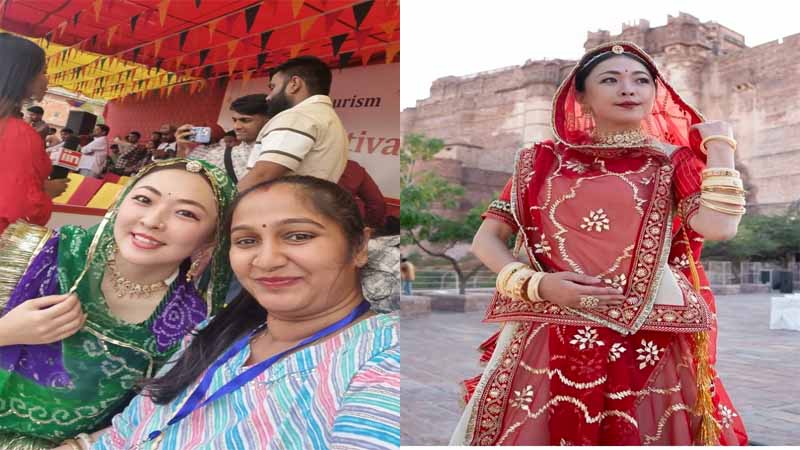
Jaipur: Rajasthan is not just a land of majestic forts, palaces, and sweeping desert landscapes—it is a living, breathing cultural tapestry that travels far beyond borders. Its vibrant folk traditions—music, dance, attire, and festivals—have the rare power to touch hearts across continents. Sometimes, that cultural pull is so profound that it transforms lives entirely, even identities.
One such remarkable story is that of Mayumi from Japan, who today is known to the world as “Rajasthani Madhu.” Her journey is a testament to the enchanting power of Rajasthan’s folk culture—so compelling that it led her to embrace a new name, a new passion, and a new home away from home. Recognizing her dedication, the Rajasthan Tourism Department has often invited and honored her at various cultural festivals.
Standing amid the vibrant procession of Gangaur in Jaipur, surrounded by colorful lehriyas and echoing folk melodies, Madhu’s eyes sparkle with the same wonder she first felt years ago in a Tokyo cinema hall. It was a Bollywood film that ignited her fascination with Rajasthan. A devoted admirer of Hrithik Roshan and Alia Bhatt, she credits Indian cinema for opening the doors to a culture she now lives and breathes.
Her first visit to India in 2009 proved to be life-changing. Drawn by a deep curiosity for folk dance, she immersed herself in Rajasthan’s artistic circles. It was here that she began learning traditional forms like Kalbelia, Ghoomar, and Chari. The soulful strains of Manganiyar music and the wisdom of her gurus helped her understand that these dances are not merely physical movements—they are expressions of the soul.
Madhu proudly considers herself a disciple of Gulabo Sapera, the legendary Kalbelia dancer, and speaks with reverence about learning the nuances of folk music from Anwar Khan Manganiyar. Her time in Jaisalmer played a pivotal role in her transformation—from Mayumi to Madhu.
Today, back in Tokyo, Madhu leads a dual life. By day, she runs a beauty salon. But as evening falls, her world shifts into rhythm and रंग. Three to four days a week, she teaches Rajasthani folk dances to Japanese students. In a modest studio, adorned with colorful odhnis and echoing with the jingling of anklets, Rajasthan comes alive thousands of miles away.
Madhu admits that promoting Rajasthani folk dance in Japan is not without its challenges. At times, she performs before very small audiences. Yet, the encouragement she receives from her students and followers on social media keeps her motivated.
Her bond with Rajasthan runs so deep that she calls it her “second home.” It is this heartfelt connection that continues to draw her back, as she participates in cultural events where she blends seamlessly into the local ethos despite being a foreigner.
The journey from “Mayumi” to “Rajasthani Madhu” is not just a change of name—it is a story of devotion, transformation, and the boundless power of culture. It reminds us that when music and tradition truly touch the soul, borders cease to matter, and one finds home wherever the heart feels alive.