
NHRC Holds Virtual Conference with State Human Rights Commissions, Stresses Digital Coordination and Institutional Strengthening
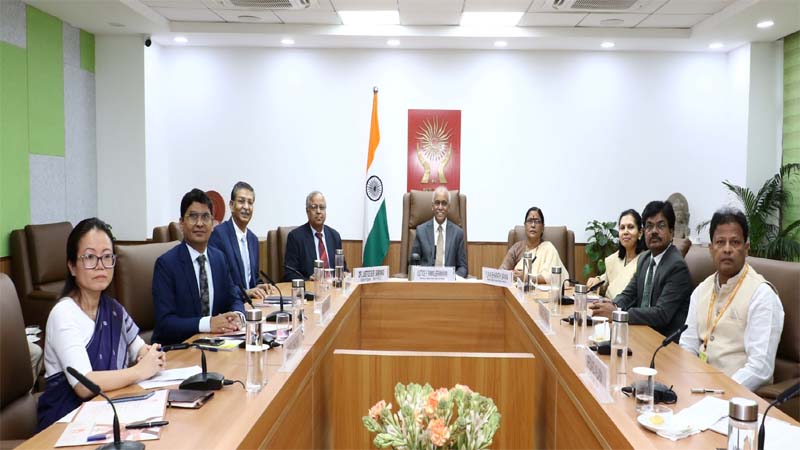
New Delhi: The National Human Rights Commission (NHRC) on Tuesday organized a one-day virtual conference from its headquarters in New Delhi with State Human Rights Commissions (SHRCs), their Special Rapporteurs, and Observers. The conference was chaired by NHRC Chairperson Justice V. Ramasubramanian and focused on strengthening India’s human rights protection framework through enhanced coordination, digital integration, and institutional capacity building.
Addressing the conference, Justice Ramasubramanian said India’s human rights framework is unique in nature, as both the NHRC and SHRCs exercise concurrent jurisdiction in several matters. He emphasized that the country’s overall human rights performance is assessed on the basis of the collective work of all commissions, making it essential to avoid duplication of cases, strengthen information-sharing systems, and adopt best practices.
He urged State Human Rights Commissions to fully digitize their operations and integrate with NHRC’s unified HRCNet portal. He also stressed that all commissions must function strictly within the jurisdiction defined under the Protection of Human Rights Act to avoid unnecessary disputes and ensure effective service delivery.
Several senior officials attended the conference, including NHRC members Justice (Dr.) Bidyut Ranjan Sarangi and Vijaya Bharathi Sayani, Secretary General Bharat Lal, and Director General Anupama Nilekar Chandra.
Justice (Dr.) Bidyut Ranjan Sarangi described stronger communication and coordination between NHRC and SHRCs as the need of the hour. He particularly highlighted the importance of swift action and effective implementation of orders in sensitive cases such as custodial deaths.
NHRC member Vijaya Bharathi Sayani called upon state commissions to increase direct engagement with affected communities. She noted that better coordination between Special Rapporteurs and Observers would significantly enhance institutional effectiveness and accountability. She also appreciated the Karnataka government’s initiative of publicly displaying contact details of the State Human Rights Commission for public assistance.
In his opening remarks, Secretary General Bharat Lal said human rights is a complex and multidimensional issue that requires collective efforts from all commissions and related institutions. He revealed that the NHRC received 4.28 lakh complaints through its online system over the past five years.
According to the data, major complaints included police-related human rights violations (18 percent), organized exploitation by mafias (17.4 percent), service-related grievances (6 percent), violations of women’s rights (5.8 percent), prison-related issues (3.5 percent), and labor rights violations.
He also expressed concern over custodial deaths, abuse in shelter homes, poor conditions in mental health institutions, deaths caused by manual scavenging, and rehabilitation challenges faced by persons with disabilities, transgender individuals, and homeless persons.
The NHRC highlighted the significance of the HRCNet portal for effective complaint management. So far, 23 State Human Rights Commissions have adopted the system, while Andhra Pradesh, Gujarat, Jharkhand, and Nagaland are yet to join. Madhya Pradesh and Rajasthan, despite integration, have not yet operationalized complaint resolution through the portal.
During two interactive sessions, representatives from various states shared their challenges and proposed several measures to strengthen the human rights framework. Key suggestions included providing adequate resources to SHRCs, enhancing digital data-sharing, conducting regular inspections of prisons, mental health institutions and shelter homes, expanding human rights education and awareness campaigns, and ensuring outreach to vulnerable communities.
Special Rapporteurs and Observers also recommended a greater focus on preventive interventions rather than punitive action after violations occur. They stressed the need for regular training of police personnel, correctional staff, and Central Armed Police Forces, along with prison reforms, stronger child protection mechanisms, and focused initiatives on mental health and environmental justice.
The conference witnessed participation from chairpersons, members, and representatives of State Human Rights Commissions from Himachal Pradesh, Haryana, Rajasthan, Uttar Pradesh, Odisha, Assam, Manipur, Tripura, Meghalaya, Nagaland, Chhattisgarh, Telangana, Gujarat, Goa, and Karnataka.
The NHRC expressed hope that such regular dialogue and coordinated efforts would further strengthen the national human rights mechanism and ensure timely prevention and redressal of human rights violations across the country.