
‘Balen Era’ Begins in Nepal: Balendra Shah Sworn in as Prime Minister at Auspicious Time 12:34 PM
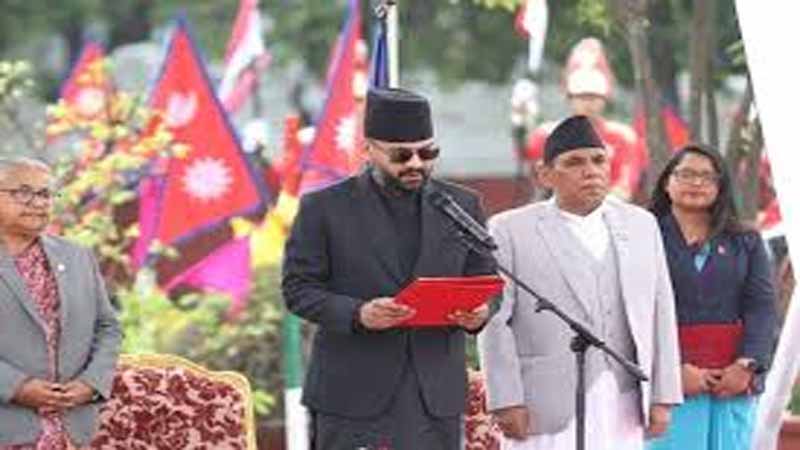
Kathmandu: Marking the beginning of a new political chapter in Nepal, rapper-turned-politician Balendra Shah, popularly known as ‘Balen’, was sworn in as the country’s youngest Prime Minister on Friday. The 35-year-old leader took oath at the auspicious time of 12:34 PM, formally ushering in what is being called the ‘Balen Era’.
The historic moment came a day after Shah was unanimously elected as the parliamentary party leader of the National Independent Party (RSP). Party’s central organization committee secretary Shankar Shrestha stated that Shah’s unanimous selection made him eligible for the nation’s highest executive office. He also confirmed that the party’s central committee has authorized Shah to form a new cabinet, with announcements expected soon.
Earlier this month, under Shah’s leadership, the RSP secured a landslide victory in the parliamentary elections, winning 182 out of 275 seats in the House of Representatives, delivering a major blow to traditional political parties. The elections were held in the aftermath of last year’s mass “Generation Z” protests, where young citizens demanded corruption-free governance and systemic political change.
Out of the 275 members in the House, 165 were elected through direct voting and 110 through proportional representation. Shah further cemented his popularity by defeating four-time Prime Minister K. P. Sharma Oli by a significant margin from the Jhapa-5 constituency, long considered an opposition stronghold.
Newly elected lawmakers took oath at the Federal Parliament Building, formally initiating the government formation process three weeks after the conclusion of voting. The oath of office and secrecy was administered by senior-most member Arjun Narsingh KC at the Federal Parliament Secretariat in Singha Durbar.
Following the ceremony, Balendra Shah was sworn in as Prime Minister at Shital Niwas (the Presidential residence). He is expected to form a cabinet comprising 15 to 18 members.
The rise of the RSP and its sweeping mandate has significantly reshaped Nepal’s political landscape. Traditional parties have seen a sharp decline, with the Nepali Congress securing just 38 seats, CPN-UML winning 25, and the Communist Party of Nepal reduced to 17 seats.
The onset of the ‘Balen Era’ is widely being seen as a symbol of political transformation, youth-driven leadership, and a shift toward a new governance paradigm in Nepal.