
From Research to Real-World Impact: Fraunhofer Deepens Indo-German AI Partnership at India AI Summit 2026
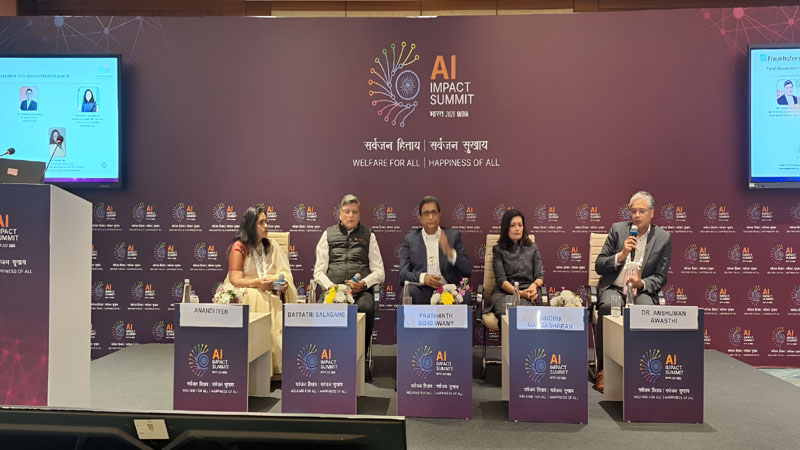
New Delhi: At the India AI Summit held at Bharat Mandapam, Fraunhofer curated multiple platforms to underscore and power Indo German partnerships in AI and allied technologies. It hosted the Indo-German Innovation and Technology Forum “AI for Economic Development and Social Good” at the Bharat Mandapam. Fraunhofer’s competencies and its partnerships in India in the fields of AI in Manufacturing, Agriculture, Health, and policy advocacy were showcased at different events.
Fraunhofer brought the leading captains of the German Industry, Mr Dattatri Salgame from Bosch, Ms Sindhu Gangadharan, SAP, Mr Prashant Doreswamy, Auvomio and Mr Anshuman Awasthi from Mercedes Benz Research and Development Centre in India together at the Indo-German Innovation and Technology Forum “AI for Economic Development and Social Good”, focusing on Manufacturing, Agriculture, Healthcare, and Trustworthy AI.
The Guest of Honour, Prof. Dr. Kristina Sinemus, Hessian Minister for Digitalisation and Innovation, State of Hessen, Germany, said that AI is already transforming how we produce, heal, grow food, and govern. The key question is not whether AI will shape our society, but how and whether economic development and social good advance together. She said our strategy is guided by a clear principle: technology must serve people, not the other way around. The minister said that India has shown with initiatives like ADA, NPI, and India Stack how digital public infrastructure can scale and enable innovation at massive levels. Germany can bring expertise in balanced regulation, data protection, and quality assurance. Together, India and Germany can build bridges between scale and safeguard, between innovation and rights, between economic development and social good, grounded in shared democratic values.
Georg Enzweiler, Deputy Chief of Mission, Embassy of the Federal Republic of Germany, New Delhi, highlighted AI’s vast potential for economic and social good, from agriculture to manufacturing, while stressing inclusive and sustainable growth. He noted Germany’s investments in AI for climate and sustainability and praised India’s strong AI talent base.
Dr. Thomas Kuhn, Head of Embedded Systems at Fraunhofer Institute for Experimental Software and Engineering, showcased exciting breakthrough technologies such as the Virtual Employee and the Dataspaces Platform for secure exchange of data and projects.
Speaking at the forum, Anandi Iyer, Director, Fraunhofer Office India, said that Fraunhofer is one of the largest applied research ecosystems in the world, with 76 institutes in Germany and a presence in more than 80 countries. She highlighted that Fraunhofer produces two patents for every working day and is the inventor of the MP3, white LEDs, and several other breakthrough technologies. Iyer underscored Fraunhofer’s immense competencies in the global innovation corridor to take research from the laboratory to the market in the shortest possible time.
“India as we all know, needs translational research and therefore, Fraunhofer has an important role to play. We are delighted that we were among the first movers coming into India 18 years ago. Even today, there are very few international R&D organizations that are active in India,” she said.
Dr Raj Kumar Kumar Upadhyay, CEO of the Center for Development of Telematics (C-Dot) shared the excellent capabilities of C-DOT is detecting and preventing fraud callas and financial threats. He stressed that the collaboration with Fraunhofer is a highly valued partnership that will accelerate technology advancement and deployment in Internet Secruity, 5G/6G, Quantum as well as AI and telecommunications.
The Women in Innovation and Technology Session was chaired by Prof. Dr. Kristina Sinemus, Hessian Minister for Innovation and Digitalisation, and Dr. Mrs. Parvinder Maini, Scientific Secretary, Office of the Principal Scientific Advisor to the Government of India. 10 Indian women leaders and 10 women leaders from German Industry and Academia shared their incredible journey, their challenges, and their triumphs. The session was energised by their call to action to create a sustained platform for cross-border collaboration, dialogue and friendship. Dr. Maini emphasized that leadership in science and technology demands “audacity, resilience, and purpose.” She called for bold yet logical decision-making in AI and climate innovation, stronger mentorship ecosystems, and deeper Indo-German co-creation, while underscoring the need for global science advisory mechanisms to address shared challenges.
At the agriculture-focused session, Raghu Chaliganti of Fraunhofer HHI and ITU stressed that scaling AI requires robust governance, interoperability, and high-quality data. He noted that fragmented digital solutions fail farmers, advocating integrated, standardized platforms delivering real-time, farmer-centric decision support to reduce climate risks and improve outcomes.