
India Records Faster Decline in Under-5 Mortality Rate Than Global Average: J.P. Nadda
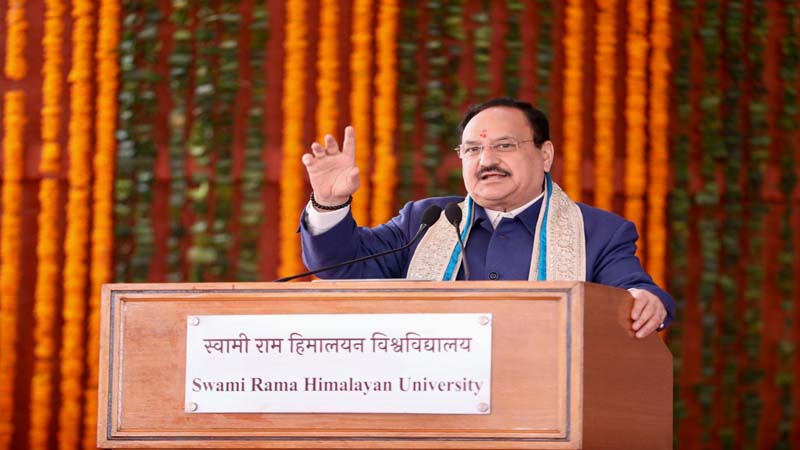
Dehradun: Union Minister for Health and Family Welfare Jagat Prakash Nadda addressed the 8th Convocation Ceremony of Swami Rama Himalayan University in Dehradun, congratulating graduating students on the successful completion of their academic journey.
Describing the convocation as both special and significant, the Minister said it symbolizes years of dedication, perseverance, and hard work, while also marking the beginning of a new phase of professional responsibility and service. He urged graduates to uphold the highest ideals of the medical profession, strive for continuous excellence, and dedicate their knowledge and skills to the service of humanity.
Highlighting the unprecedented growth in India’s health sector over the past eleven years, Mr. Nadda noted that the number of AIIMS institutions has increased from 6 to 23, significantly expanding access to advanced tertiary healthcare services across the country. He further stated that institutional deliveries have risen to nearly 89 percent, reflecting the strengthening of maternal healthcare systems.
The Minister pointed out that the Maternal Mortality Ratio (MMR) has declined from 130 per lakh live births a decade ago to 88 per lakh live births, while the Infant Mortality Rate (IMR) has reduced from 39 per 1,000 live births to 27 per 1,000 live births—indicating steady progress in maternal and child health outcomes.
Citing estimates from the World Health Organization and United Nations agencies, Mr. Nadda said India has recorded a significantly faster decline in the under-five mortality rate over the past decade compared to the global average. This, he said, reflects the impact of targeted policy interventions and expanded access to healthcare services. Referring to tuberculosis control efforts, he added that India has achieved a substantial reduction in TB cases through sustained public health measures and community-based interventions, outperforming global average reductions.
The Union Health Minister also recalled India’s historic COVID-19 vaccination drive, under which more than 220 crore vaccine doses, including precautionary and booster doses, were administered nationwide—demonstrating the scale, resilience, and efficiency of the country’s public health system.
Emphasizing financial protection in healthcare, Mr. Nadda highlighted the Ayushman Bharat Pradhan Mantri Jan Arogya Yojana, which provides health insurance coverage of ₹5 lakh per family. He stated that the scheme now benefits approximately 62 crore people, covering nearly 40 percent of India’s population. Citing evidence from reputed international medical journals and independent evaluations, he said the scheme has significantly improved timely access to cancer treatment and strengthened financial protection for eligible beneficiaries.
He further noted that out-of-pocket healthcare expenditure in India has declined substantially over the past decade, reducing the financial burden on families, particularly those from economically weaker sections. Despite representing nearly one-sixth of the global population, India has also made significant progress in reducing malaria cases and mortality through sustained vector-borne disease control efforts, in line with trends reported by the WHO.
Underlining the importance of comprehensive primary healthcare, the Minister stated that over 1.82 lakh Ayushman Arogya Mandirs are functioning across the country as primary points of contact for citizens. Of these, 50,000 centres have been certified under the National Quality Assurance Standards (NQAS), with a target to scale this number to one lakh in the near future.
Concluding his address, Mr. Nadda reiterated that the strength of India’s healthcare system ultimately depends on the commitment, competence, and compassion of its medical professionals.
Speaking on the occasion, Uttarakhand Chief Minister Pushkar Singh Dhami congratulated the graduating students and highlighted the state government’s efforts to strengthen healthcare infrastructure, medical education, and emergency services, particularly in remote and hilly areas. He emphasized the role of institutions like Swami Rama Himalayan University in developing a skilled healthcare workforce for the state and the nation.
Uttarakhand’s Minister for Medical Health and Higher Education Dhan Singh Rawat also addressed the gathering, appreciating the university’s contribution to advancing medical and higher education. He encouraged graduates to actively contribute to research, innovation, and public health services, especially in underserved regions.
Established with a vision to promote excellence in healthcare and higher education, Swami Rama Himalayan University has emerged as a leading institution in the Himalayan region, offering a wide range of undergraduate, postgraduate, and doctoral programmes in medical, paramedical, nursing, management, engineering, and allied sciences.
Degrees were conferred across various disciplines during the ceremony, marking a significant academic milestone for the graduating students. The event was attended by Dr. Vijay Dhasmana, President of the University, Dr. Rajendra Dobhal, Vice-Chancellor, along with senior dignitaries, faculty members, parents, and students.