
Make in India and America First: Partnership Towards shared prosperity
Dr. Dhananjay giri
Over the past decade, India has emerged as one of the fastest-growing major economies in the world. This trajectory has been supported by structural reforms, fiscal consolidation efforts, improvements in regulatory governance, and enhanced digital and financial inclusion initiatives undertaken under the leadership of Prime Minister Narendra Modi. These measures have strengthened macroeconomic stability and expanded India’s long-term growth potential. Projections from multiple international financial institutions suggest that India is positioned to become the world’s third-largest economy by 2030, contingent upon sustained reform momentum and global economic stability. The most recent Economic Survey similarly highlights the role of policy continuity and institutional strengthening in sustaining growth amid heightened global uncertainty.
A robust domestic economic base has also enhanced India’s capacity to pursue external economic engagement with greater strategic clarity. Economic statecraft is typically most effective when grounded in internal macroeconomic stability and institutional credibility. In this context, India has actively expanded its trade architecture over the past five years through the negotiation and conclusion of more than fifteen Free Trade Agreements (FTAs) and Comprehensive Economic Partnership Agreements (CEPAs). These agreements reflect a broader shift toward diversified trade partnerships and supply-chain integration.
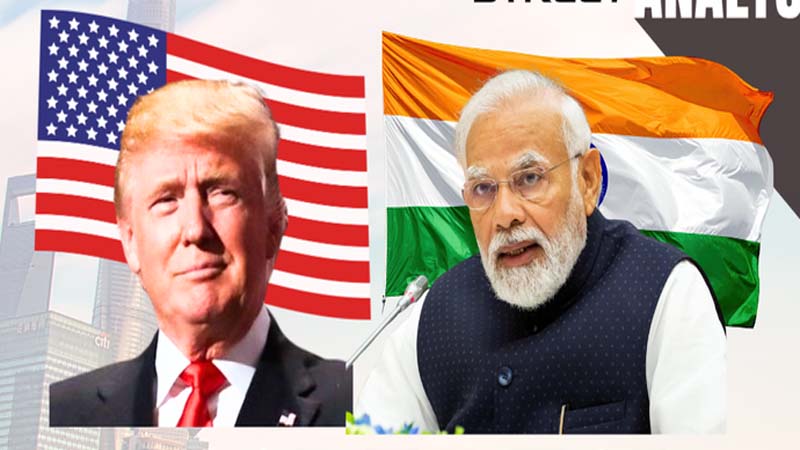
Among these initiatives, the evolving trade framework between India and the United States represents a significant development in bilateral economic relations. The agreement builds upon commitments articulated in the Joint Leaders’ Statement issued in February of the preceding year, wherein both countries reaffirmed their intention to expand bilateral trade and investment flows. The stated objectives included enhancing innovation ecosystems, strengthening resilient supply chains, advancing national security considerations, and promoting employment generation.
Although the India–U.S. Bilateral Trade Agreement remains in the process of finalisation, its preliminary structure indicates an effort to resolve long-standing trade frictions and restore predictability to bilateral commerce. The agreement must be understood within the broader context of the comprehensive global strategic partnership between the two democracies, where economic cooperation increasingly intersects with technological, geopolitical, and security considerations.
A central feature of the agreement involves tariff rationalisation and reciprocal market access adjustments. India’s export base to the United States—valued at approximately USD 86.35 billion in 2024—stands to be significantly affected by the restructuring of reciprocal tariffs. Previously, certain categories of Indian exports were subject to duties as high as 50 percent. Under the revised framework, tariffs on USD 30.94 billion worth of exports have reportedly been reduced from 50 percent to 18 percent, while an additional USD 10.03 billion in exports has transitioned to zero-duty access.
Further provisions include continued zero reciprocal duty on USD 1.04 billion worth of exports—primarily agricultural goods—under established exemption categories. Additionally, products valued at USD 28.30 billion falling under Section 232 provisions (applied on an end-use basis) are expected to receive zero reciprocal duty, with previously imposed additional duties eliminated. Collectively, these measures may create a relative tariff advantage for Indian exporters vis-à-vis competitors facing higher U.S. duties, thereby enhancing price competitiveness in selected sectors.
The agreement adopts a phased approach to tariff elimination for specific goods. Gradual liberalisation allows domestic producers adjustment time to reconfigure supply chains, upgrade productive capacity, and improve technological competitiveness. Such sequencing is consistent with trade-adjustment theory, which emphasises transition buffers to mitigate sectoral dislocation. Immediate tariff elimination is reportedly limited to non-sensitive product categories, many of which are already liberalised under other trade agreements, thereby reflecting a calibrated balancing of openness and domestic safeguards.
From a macroeconomic perspective, the agreement may contribute to strengthening India’s trade surplus with the United States. Estimates referenced in recent financial analyses suggest that, contingent on export expansion and import elasticity, the bilateral surplus could potentially exceed USD 90 billion annually. However, such projections remain dependent on global demand conditions, exchange-rate stability, and sector-specific competitiveness.
Beyond immediate trade effects, the agreement has broader implications for global supply-chain integration. By combining expanded market access with selective domestic protections, India signals its intention to position itself as a reliable participant in high-value manufacturing and emerging technology ecosystems. In this regard, the convergence between India’s “Make in India” and “Aatmanirbhar Bharat” initiatives and the United States’ industrial policy priorities suggests a model of complementary economic nationalism—where domestic capacity-building coexists with strategic international partnership.
India’s growing role in joint development and manufacturing of critical and emerging technologies further reinforces the economic dimension of the broader strategic partnership. Economic interdependence between the two countries increasingly intersects with defence cooperation, digital governance frameworks, and multilateral platforms such as the Quad.
Historical experience underscores the significance of maintaining openness in global trade systems. The protectionist escalation associated with the Smoot–Hawley Tariff Act of 1930 is frequently cited as an example of how inward-looking trade policies can disrupt global economic linkages. Subsequent U.S. policy recalibrations under President Franklin D. Roosevelt reflected recognition of the difficulty in restoring disrupted trade channels. These historical precedents continue to inform contemporary debates on trade resilience and strategic interdependence.
In sum, the India–United States trade agreement represents an effort to institutionalise economic cooperation within a structured, rules-based framework. By reducing tariff barriers, promoting sectoral integration, and aligning long-term economic objectives, the agreement may contribute to sustainable bilateral growth. Its ultimate impact, however, will depend on implementation mechanisms, sectoral responsiveness, and evolving global economic conditions.

(The author is a political analyst and association.)