
World Book Fair: Audience Enthralled by Performances Celebrating Valor and Folk Traditions
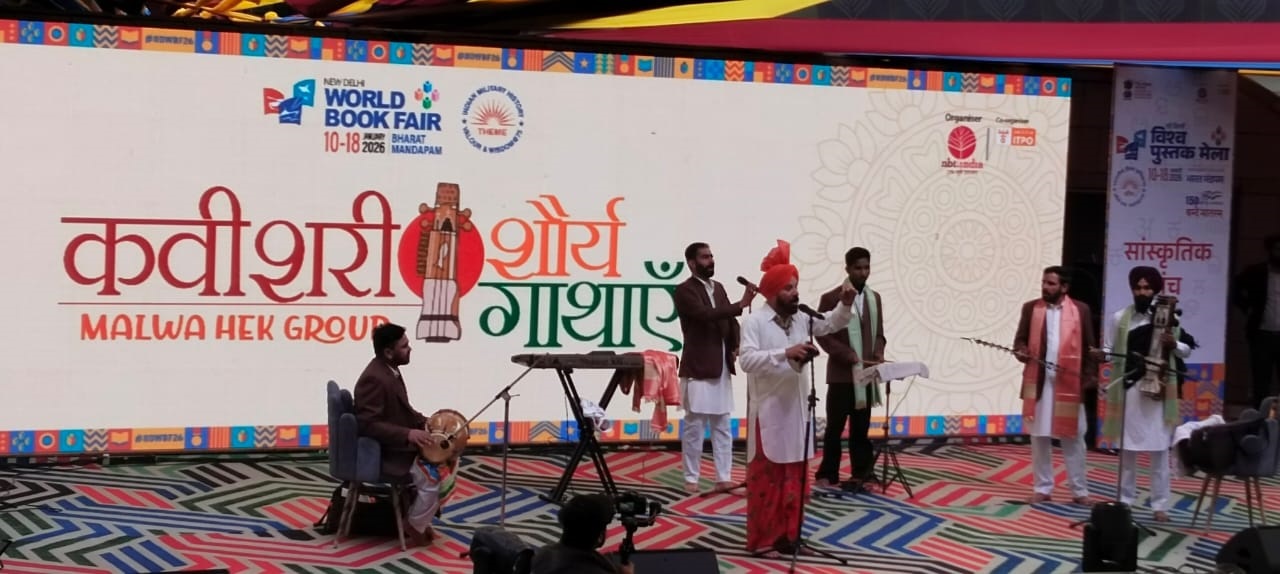
New Delhi: A vibrant cultural evening dedicated to India’s freedom struggle and rich folk traditions was held on Friday at the World Book Fair, where audiences warmly applauded the Punjabi-language programme “Shaurya Gathayen” (Tales of Valor).
The highlight of the evening was a powerful Kavishari performance by the Malwa Haik Group. Kavishari is a traditional Punjabi art form that blends poetry, music, and storytelling to narrate tales of courage and sacrifice. Through emotive singing and rhythmic narration, the performers presented patriotic compositions and verses from Gurbani, evoking memories of the bravery and spirit of resistance shown by India’s freedom fighters.
One of the most memorable moments of the evening was the rendition of the iconic Punjabi song “Yeh Dharti Panj Dariyavan Di”, which poetically describes Punjab as the land of five rivers—Sutlej, Beas, Ravi, Chenab, and Jhelum. Widely regarded as a cultural ode to Punjab’s fertile land, resilience, and history of sacrifice, the song deeply resonated with the audience and stirred strong feelings of regional pride.
The singers also performed the revered Gurbani composition “Gagan Damama Bajyo”, attributed to Bhagat Kabir. Using the metaphor of war drums resounding in the sky, the hymn portrays struggle as a righteous fight against injustice and oppression. The performance highlighted the philosophical depth of the verse, presenting conflict not merely as a physical battle, but as a moral duty to uphold truth and courage.
Another striking presentation depicted revolutionary Udham Singh taking an oath after the Jallianwala Bagh massacre, a moment that prompted deep reflection among the audience and drew sustained applause.
The cultural evening concluded with an energetic Dangi dance performed by tribal artists from the Dangi region. Located in the hilly forest areas of southern Gujarat, the Dangi region is known for its rich tribal heritage. Marked by vigorous movements and traditional rhythms, the dance symbolized communal harmony, reverence for nature, and the preservation of ancestral traditions, bringing the evening to a powerful and celebratory close.