
Rajasthan’s ‘Film Frame’ Emerges in Berlin
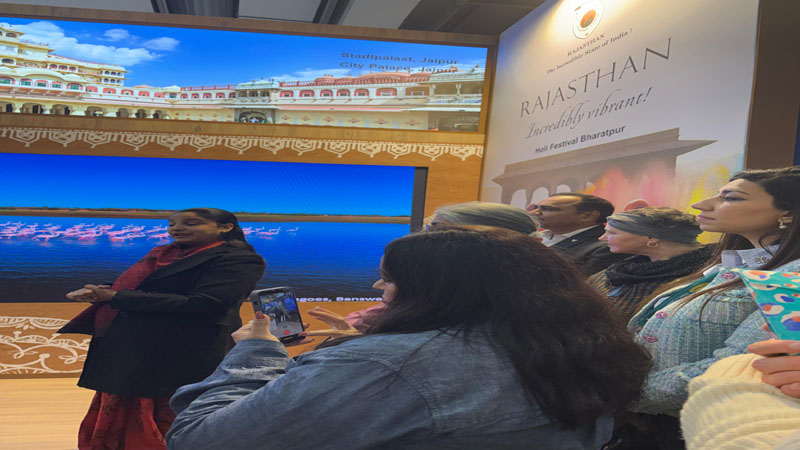
Jaipur/Berlin: Amid the global gathering of tourism and creative industry leaders at ITB Berlin, Rajasthan highlighted a new dimension of tourism — film tourism — presenting its recently announced Rajasthan Film Tourism Promotion Policy to international stakeholders.
At the Rajasthan pavilion, Tourism Commissioner Rukmani Riyar, Additional Director Pawan Jain and Joint Director Dr. Puneeta Singh engaged in an engaging discussion with international delegates about the growing potential of cinematic tourism in the state. Representatives from Europe, Asia and the United States, including tour operators and location scouts, showed keen interest in Rajasthan as a potential filming destination.
The presentation was not merely about promoting a government initiative. It also highlighted the nearly century-old cinematic connections between India and Germany, opening the door to new collaborations between the tourism and film industries.
Rajasthan: A Natural Film Destination
Rajasthan has long attracted filmmakers due to its distinctive visual landscape. Majestic forts, grand palaces, serene lakes and sweeping desert vistas provide a unique cinematic backdrop that has captivated international filmmakers for decades.
The state gained global cinematic recognition when parts of the Octopussy (1983) from the James Bond film series were filmed in Udaipur. Later, films such as The Best Exotic Marigold Hotel (2011) and The Dark Knight Rises (2012) further showcased Rajasthan’s heritage to international audiences.
European filmmakers have also found inspiration in the state. Renowned German director Werner Herzog shot his film Jag Mandir (1991) at the City Palace Udaipur and Jag Mandir. Similarly, the British-German-French co-production The Warrior (2001) set its story in medieval Rajasthan and filmed several scenes in the state’s desert regions.
A Century of Indo-German Film Collaboration
The cinematic relationship between India and Germany dates back to the 1930s. Indian filmmaker Himanshu Rai collaborated with Germany’s renowned film company UFA to produce internationally oriented films. German director Franz Osten and cinematographer Josef Wirsching travelled to India and played an influential role in introducing modern filmmaking techniques and studio systems.
This collaboration eventually led to the establishment of Bombay Talkies in Mumbai in 1934 by Himanshu Rai and actress Devika Rani. The studio soon became one of the most advanced production centres in Indian cinema. Films such as Achhut Kanya (1936) set new standards in both storytelling and technical quality.
Over the years, cooperation continued to grow. In 2005, India and Germany signed an official film co-production agreement, enabling filmmakers from both countries to collaborate more easily on joint projects.
Germany’s prestigious Berlin International Film Festival has also served as an important platform for Indian cinema, showcasing diverse works ranging from the classic films of Satyajit Ray to contemporary independent productions.
New Opportunities for Film Tourism
In this historical context, Rajasthan’s new film tourism policy is being viewed as a strategic step to attract global filmmakers. The policy includes provisions such as subsidies, incentives and simplified permission procedures for film shoots.
Tourism and film industry experts believe that if implemented effectively, Rajasthan could emerge as a major hub for international film production in the coming years.
The scale of ITB Berlin further amplifies this opportunity. Held from March 3 to 5, the event brought together tourism boards from more than 190 countries, around 5,500 exhibitors and over 100,000 trade visitors, making it one of the world’s most influential tourism platforms.
Discussions at the Rajasthan pavilion indicated that the global film industry today is not just searching for picturesque locations but also destinations offering efficient shooting facilities, administrative support and creative local resources. With its architectural grandeur, historical heritage and geographic diversity, Rajasthan is naturally positioned to meet these expectations.
If international film projects increase in the state in the coming years, the impact will extend beyond tourism. It could create new opportunities for local artists, technicians, craftsmen and service industries. In that sense, the initiative presented in Berlin represents not just a policy announcement but the opening of a new creative industry frontier for Rajasthan.