
India must become global hub of drone manufacturing in next few years amid current geopolitical instability: Raksha Mantri at National Defence Industries Conclave 2026
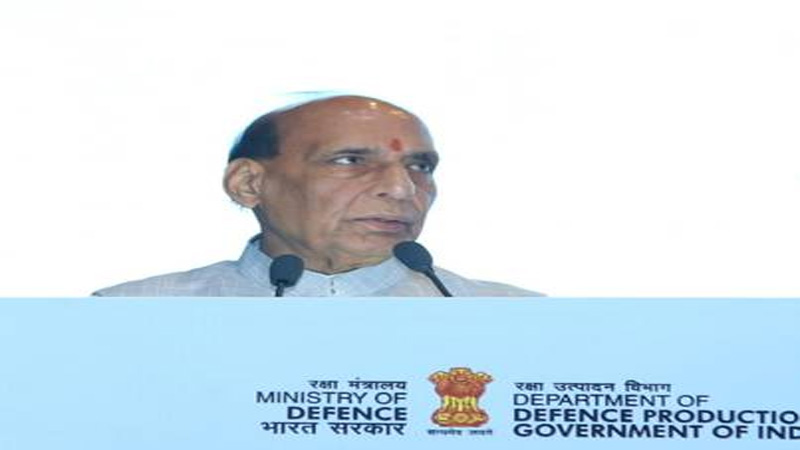
New Delhi : “India must work in a mission mode to emerge as a global hub of indigenous drone manufacturing in the next few years,” said Raksha Mantri Shri Rajnath Singh as he stressed on the urgent need to build a drone production ecosystem to ensure strategic autonomy, enhance defence preparedness and make the country Aatmanirbhar in view of the present geopolitical uncertainties. He was addressing MSMEs, start-ups, winners of Innovations for Defence Excellence (iDEX), Defence Public Sector Undertakings (DPSUs), private defence companies, innovators, policymakers, and academia during the inaugural session of the two-day National Defence Industries Conclave, organised by the Department of Defence Production on the theme ‘Advanced Manufacturing Technologies’ at Manekshaw Centre, New Delhi on March 19, 2026.
Raksha Mantri asserted that the ongoing conflicts, ranging from the Russia-Ukraine war to the tensions between Iran & Israel, are proof that drones and counter-drone technologies are destined to play a pivotal role in future warfare, and self-reliance in drone manufacturing is essential not merely at the product level, but at the component level as well. “From the drone’s molds to its software, engines, and batteries, everything must be manufactured in India. This is no easy task. In most countries where drones are manufactured, a significant number of critical components are currently imported from China,” he said.
Shri Rajnath Singh added that while the creation of any nation’s defence industrial ecosystem relies on the contributions of large industries, MSMEs, start-ups, and innovators, it is equally driven by a clear policy push from the government, tailored to meet the country’s specific defence requirements. While he called for active contribution of the private sector, he extended Prime Minister Shri Narendra Modi-led Government’s full support to transform India into a global hub for indigenous drone manufacturing.
As part of the inaugural session, Raksha Mantri launched the 14th edition of Defence India Start-up Challenge (DISC-14) and the 4th edition of ADITI challenges under the iDEX framework. A total of 107 problem statements, including 82 under DISC-14 & 25 under ADITI Challenges 4.0, from the Defence Forces, Indian Coast Guard and Defence Space Agency were launched to promote breakthrough innovations in various domains.
A new initiative featuring 101 innovation challenges from DPSUs was also launched by Raksha Mantri to encourage design-led innovation by MSMEs and start-ups. These challenges are funded by DPSUs, which will also provide mentorship, testing facilities and opportunities for potential integration into their supply chains to the winning start-ups.
Shri Rajnath Singh described iDEX and ADITI (Acing Development of Innovative Technologies with iDEX as game-changer initiatives, through which start-ups, innovators, and MSMEs are provided with the opportunity to develop novel solutions to meet the specific requirements of the Defence Forces. “As of February 2026, approximately 676 start-ups, MSMEs, and individual innovators have joined the defence innovation ecosystem since the inception of iDEX in 2018. 548 contracts have been signed; and 566 challenges launched. Of these, 58 prototypes have received clearance for procurement, valued at around Rs 3,853 crore. Furthermore, 45 procurement contracts have already been signed, worth nearly Rs 2,326 crore. These figures demonstrate that innovation is gradually materialising into tangible products & technologies, and the role played by our start-ups & MSMEs in this transformation is steadily gaining strength,” he said.
Raksha Mantri emphasised that MSMEs are today actively engaged in fields such as Artificial Intelligence, Robotics, Automation, and Advanced Manufacturing, representing a monumental and positive transformation. He termed it as imperative for the MSMEs and start-ups to embrace and integrate these technologies to ensure the optimal utilisation of their resources and capabilities. “In the contemporary landscape, innovations such as Automation, Artificial Intelligence, Robotics, and Additive Manufacturing are reshaping the global manufacturing sector. Furthermore, technologies like ‘Digital Twins’ and advanced simulation tools are unlocking a host of new possibilities. A ‘Digital Twin’ essentially involves creating a virtual model of a real-world system. Such technologies empower us to better comprehend complex systems and facilitate more informed decision-making,” he said.
Shri Rajnath Singh added that ‘integration’ is another crucial concept for the enhancement of MSME capabilities. “This integration can be achieved in two distinct ways: Horizontally and Vertically. Horizontal integration implies that MSMEs from diverse sectors connect with one another, learn from each other’s experiences, and collaborate. Vertical integration signifies that MSMEs partner with large-scale industries, engage with emerging technological domains, and cultivate expertise in fields such as Artificial Intelligence, Automation, Robotics, and Additive Manufacturing. Our MSMEs must advance towards the adoption of Industry 4.0. It is when both horizontal and vertical integration occur simultaneously that a robust innovation ecosystem is established,” he said.
Highlighting the numerous initiatives undertaken by the Government to strengthen the MSMEs, Raksha Mantri stated that a three-pronged approach has been introduced in this year’s Union Budget to provide MSMEs with Equity, Liquidity, and Professional support, thereby enabling them to emerge as ‘Champion MSMEs’. The objective is to accelerate the growth of MSMEs, and enhance their competitiveness in both domestic and international markets, he said.
Shri Rajnath Singh pointed out that since 2014, the Government has consistently prioritised and focused on the expansion of this “vital” sector. To simplify the registration and identification of MSMEs, digital platforms such as the Udyam Portal and the Udyam Assist Portal have been launched. The objective is to integrate small industries into the formal economy, thereby ensuring that they receive the benefits of government schemes.” he said. He added that the number of MSMEs in the country stood at approximately 4.67 crore in 2012-13, and the figure has reached nearly 08 crore, according to recent data. This growth, he said, demonstrates the continuous rise in the spirit of entrepreneurship within the country, and small industries are now playing a significant role in driving economic growth.
“We see start-ups serving as catalysts for social change through their truly unique ideas, while others attain the coveted status of a ‘Unicorn’ within an incredibly short span of time. In the near future, many more will emerge as the next generation of ‘Unicorns’. All that is required is consistent effort, perseverance, and unwavering dedication,” said Raksha Mantri, urging the MSMEs and start-ups to march forward with zeal & enthusiasm to innovate, embrace new technologies, and realise the vision of Aatmanirbhar Bharat and Viksit Bharat.
Speaking on the occasion, Secretary (Defence Production) Shri Sanjeev Kumar highlighted that the conclave aims to promote advanced manufacturing technologies, and integration of MSMEs in the production ecosystem and entire value chain starting from design, development and manufacturing. He added that the 200 Problem Statements will give an opportunity to MSMEs, industries, start-ups, young innovators in designing state-of-the-art products and enhance their skills.
The Secretary (DP) enumerated the series of steps taken by the Ministry to promote and strengthen the domestic defence industry during 2025 – Year of Reforms. “DDP implemented significant reforms including rationalisation and simplification of various approvals and permissions; strengthening of quality process and bringing testing laboratories belonging to DPSUs and DRDO. A digital database of industries working in the defence sector, named Srijan Deep, has also been created, wherein over 40,000 industries have been listed to increase the resource for R&D,” he said.
During the event, Raksha Mantri also released 05 publications of Department of Defence Production, which aim to strengthen awareness of policy initiatives, promote defence exports and facilitate ease of doing business for industry stakeholders. These are:
SAMARTHYA 2026 – A Journey Towards Self-Reliance in Defence Production: A document outlining the roadmap and key initiatives to strengthen self-reliance in defence manufacturing.
Indian Defence Industry – Going Global: A report highlighting India’s growing defence exports and opportunities for Indian companies in the global market.
SANKLAN: A handy guide providing answers to common queries of defence companies and MSMEs.
Enabling Provisions to integrate MSMEs in Defence PSU ecosystem: A booklet outlining new measures to integrate MSMEs into the DPSU ecosystem.
AI Maturity Assessment Model: A framework to help defence organisations assess and improve their adoption of Artificial Intelligence technologies.
Shri Rajnath Singh also inaugurated an exhibition, wherein 20 large defence companies have set up their stalls to showcase their initiatives and programmes for co-opting MSMEs as partners, suppliers and innovators. In addition, 24 Indian and foreign companies are participating in the exhibition to display advanced manufacturing technologies such as automation, artificial intelligence, robotics, additive manufacturing and smart materials.
Chief of Defence Staff General Anil Chauhan, Chief of the Naval Staff Admiral Dinesh K Tripathi, Chief of the Army Staff General Upendra Dwivedi, Defence Secretary Shri Rajesh Kumar Singh, Secretary, Department of Defence R&D and Chairman, DRDO Dr Samir V Kamat and other senior officials were present on the occasion.