
Suvendu Adhikari: Bengal’s Emerging “Giant Killer” in Indian Politics
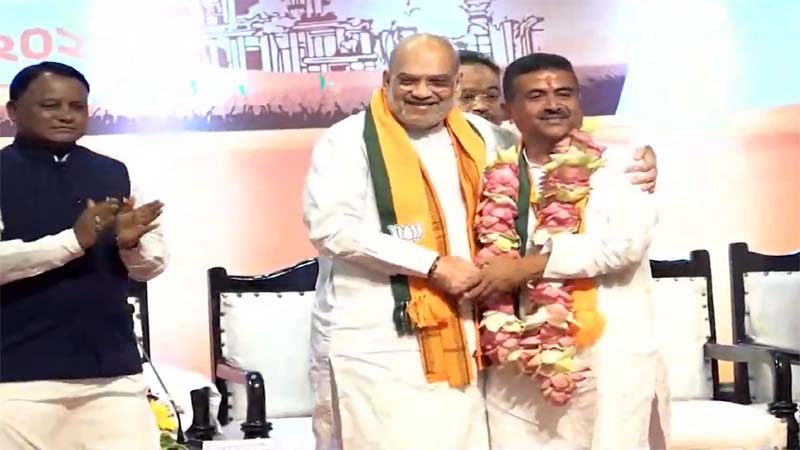
Kolkata: In sports, a player who unexpectedly defeats a far stronger opponent is often called a “giant killer.” Indian politics, too, has witnessed several such figures over the decades—leaders who have stunned established political heavyweights and altered the course of electoral history.
Names like Subrat Pathak, who defeated Dimple Yadav in Kannauj, Smriti Irani, who unseated Rahul Gandhi in Amethi, and K.P. Yadav, who defeated Jyotiraditya Scindia in Guna, are often cited as examples. Going further back, George Fernandes earned this title in the 1970s when he defeated Congress stalwart S.K. Patil from Bombay South.
Now, political observers increasingly place Suvendu Adhikari in that category.
The Making of a Political Challenger
Suvendu Adhikari’s rise is not merely the story of a politician switching sides. It is the story of a leader who moved from being one of the closest associates of West Bengal Chief Minister Mamata Banerjee to becoming one of her most formidable challengers.
His political shift in December 2020, when he resigned from the Trinamool Congress and joined the BJP, marked a decisive turning point in Bengal politics.
For many analysts, this was not just a resignation—it was a strategic rupture that altered the political equations of the state.
Nandigram: The Psychological Turning Point
The 2021 Nandigram contest is widely regarded as the defining chapter of Adhikari’s political journey.
That battle carried significance beyond electoral arithmetic. It challenged the perception of political invincibility that had long surrounded Bengal’s ruling establishment.
Political analysts argue that the contest sent a powerful message: no political fortress is impregnable.
The symbolism of that electoral challenge reshaped political discourse in Bengal and gave BJP supporters renewed confidence that the state’s political narrative could change.
Insider Knowledge as Strategic Strength
One of Adhikari’s greatest political assets has been his deep understanding of Bengal’s grassroots political machinery.
Having spent years within the Trinamool Congress, he developed intimate knowledge of booth-level structures, regional political dynamics, organizational strategies, and local leadership equations.
This insider perspective, many believe, allowed him to challenge entrenched systems with unusual precision.
Political observers often note that in politics, understanding an opponent’s strengths and vulnerabilities is crucial—and Adhikari’s experience gave him exactly that advantage.
Why the “Giant Killer” Label?
The term “giant killer” is typically reserved for those who not only challenge established power but also fundamentally disrupt political assumptions.
Supporters argue that Adhikari’s political trajectory fits this description.
His journey from being a key architect within Bengal’s ruling political structure to becoming one of its sharpest critics reflects a rare transformation.
As one analyst put it, “When the architect of a structure rebels, the cracks become visible from within.”
What Lies Ahead?
West Bengal remains one of India’s most politically dynamic states, with intense competition between rival forces shaping its future.
In this evolving landscape, Suvendu Adhikari’s role is likely to remain central.
Whether he ultimately emerges as the face of a broader political transformation will depend on his ability to convert tactical victories into sustained mass support.
What is already clear, however, is that he has established himself as one of the most consequential political figures in contemporary Bengal politics—one whose moves will continue to shape the state’s political direction in the years ahead.