Cabinet Passes Resolution Congratulating PM Modi on Record Tenure, Approves Major Infrastructure Projects
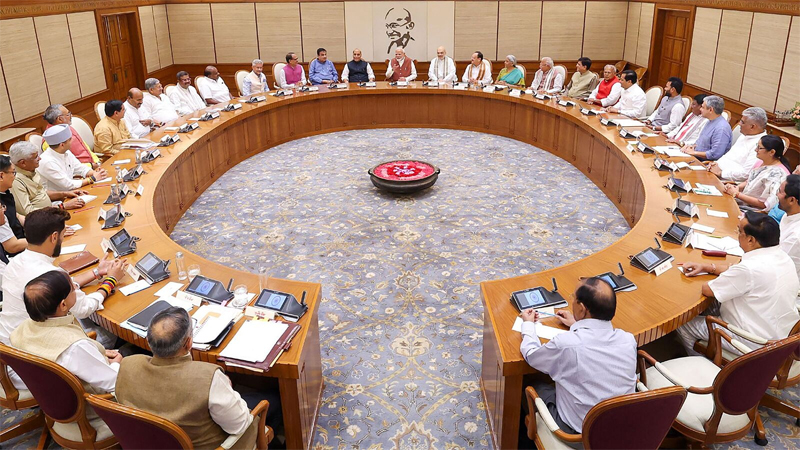
New Delhi: The Union Cabinet, chaired by Prime Minister Narendra Modi, took several significant decisions at its meeting on Wednesday. The Cabinet also passed a special resolution congratulating the Prime Minister on becoming the longest-serving elected Prime Minister in India’s history and reaffirmed its commitment to advancing the vision of a “Viksit Bharat” (Developed India).
Cabinet ministers welcomed Prime Minister Modi with a standing ovation upon his arrival at the meeting. Briefing the media afterward, Union Information and Broadcasting Minister Ashwini Vaishnaw outlined the key decisions taken by the Cabinet.
Cabinet Congratulates PM Modi on Historic Milestone
The Cabinet passed a special resolution recognizing Prime Minister Modi’s completion of 4,399 consecutive days in office as an elected Prime Minister, surpassing the previous record of 4,398 consecutive days held by India’s first Prime Minister, Jawaharlal Nehru.
The resolution described the achievement as a historic symbol of Indian democracy, public participation, and the trust reposed by citizens in democratic institutions. It noted that the milestone comes as the National Democratic Alliance (NDA) government under Prime Minister Modi completes twelve years in office and after the electorate renewed its mandate for a third consecutive term, a feat achieved after six decades.
The resolution highlighted the government’s commitment to the principle of “Sabka Saath, Sabka Vikas” and its focus on welfare-driven governance. It cited initiatives that have provided millions of citizens with permanent housing, electricity connections, clean drinking water, direct benefit transfers, free food grains for 800 million people, and healthcare coverage for more than 600 million citizens.
According to the resolution, these measures have helped more than 250 million people rise out of poverty. It also highlighted India’s emergence as the world’s third-largest startup ecosystem, driven by innovation and entrepreneurship among the youth.
The Cabinet further praised initiatives aimed at women’s empowerment, including the Lakhpati Didi programme and legislation providing 33 percent reservation for women in legislatures.
Recognition of Reforms and National Security Measures
The resolution also referred to several major reforms and policy decisions undertaken during the Modi government’s tenure, including the abrogation of Article 370, implementation of the Goods and Services Tax (GST), One Rank One Pension (OROP), the Citizenship Amendment Act (CAA), the Bharatiya Nyaya Sanhita, and labour law reforms.
It also highlighted measures related to national security, including surgical strikes, air strikes against terrorism, Operation Sindoor, actions against Left-Wing Extremism, and peace agreements in the Northeast. The Cabinet expressed confidence that under Prime Minister Modi’s leadership, India would achieve its goal of becoming a developed nation by 2047.
Ahmedabad Metro Expansion Approved
Among the major policy decisions, the Cabinet approved Phase 2-C of the Ahmedabad Metro Rail Project. The approximately six-kilometre corridor will include five stations—four elevated and one underground—and will connect Koteshwar Road with Ahmedabad Airport.
With an estimated cost of over ₹2,179 crore, the project will expand the Ahmedabad-Gandhinagar metro network to nearly 78 kilometres. The government said the corridor will improve airport connectivity, reduce traffic congestion, and contribute to environmental sustainability. The project is expected to generate around 2,000 jobs during construction and 500 jobs during operations.
Housing Complex for Central Government Employees in Amaravati
The Cabinet Committee on Economic Affairs also approved the construction of a residential complex for Central Government employees in Amaravati, the new capital city of Andhra Pradesh.
The project will be developed across 17 acres and will include 11 residential towers comprising 1,504 housing units. The estimated investment exceeds ₹1,234 crore.
The complex will feature modern amenities such as a bank, post office, childcare centre, cafeteria, guest house, and shopping facilities. It will be developed in accordance with green building standards and designed to ensure accessibility for persons with disabilities. The project is expected to generate approximately 700,000 man-days of employment annually during construction and 50,000 man-days during operation.
Central Government Office Complex Also Approved
In another major decision, the Cabinet approved the construction of a Central Government Office Complex in Amaravati. Spread across 5.3 acres, the complex will comprise two large office buildings with seating capacity for approximately 8,000 officers and staff.
The project, estimated to cost around ₹1,299 crore, will include facilities such as a bank, post office, conference halls, a multipurpose auditorium, and food courts. It will also adhere to green construction standards.
According to the government, consolidating multiple Central Government offices within a single campus will improve administrative efficiency and enhance the delivery of public services in the state.
Commitment to Viksit Bharat
The Cabinet expressed confidence that under Prime Minister Modi’s leadership, India is moving steadily toward the goal of becoming a self-reliant, secure, and prosperous nation. It noted that over the past twelve years, political stability, decisive leadership, and long-term policy reforms have helped establish India as one of the world’s fastest-growing major economies.
The ministers also wished Prime Minister Modi good health and a long life, expressing confidence that India will achieve its vision of becoming a developed nation by 2047 under his leadership.