
Mojtaba Khamenei Claims Trump Signed Peace Deal Out of “Desperation”; U.S. Lifts Naval Blockade on Iran
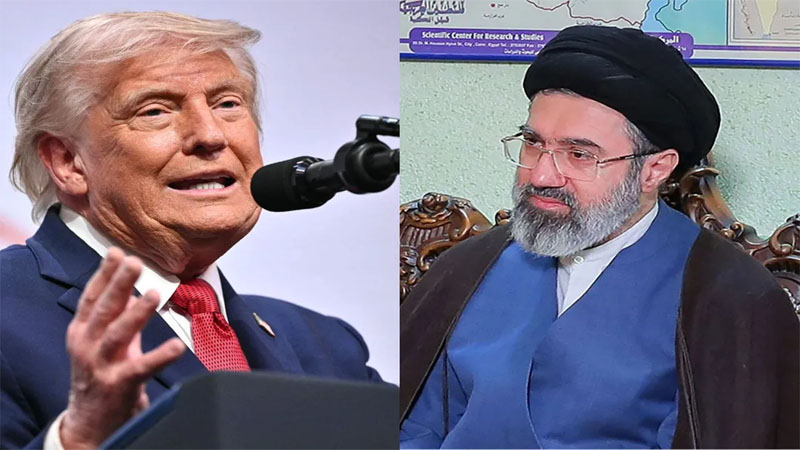
Tehran/Washington: A major geopolitical shift has emerged in the Middle East following the signing of a historic Memorandum of Understanding (MoU) between the United States and Iran aimed at easing months of military tensions and reducing the risk of a wider regional conflict. Just one day after the agreement was formalized, political rhetoric intensified as Iran’s Supreme Leader, Mojtaba Khamenei, accused U.S. President Donald Trump of being “desperate” to secure the deal and using “every possible tactic” to bring it to completion.
At the same time, the United States has officially begun implementing key provisions of the agreement, including the removal of its naval blockade on Iran, a move widely seen as a significant step toward restoring stability in the region and reopening critical energy supply routes.
Khamenei Defends Approval of the Agreement
In his first public remarks since the signing of the accord, Khamenei told the Iranian people that he had initially opposed the agreement “on principle.” However, he said he ultimately approved it after receiving assurances from President Masoud Pezeshkian and members of Iran’s Supreme National Security Council that the country’s interests and those of the “Resistance Front” would be protected.
Khamenei stated that Iranian officials had worked diligently and in good faith throughout the negotiations, adding that the American side was especially eager to see the agreement finalized.
“Responsible officials made sincere efforts with genuine concern and goodwill,” he said. “And, of course, it was the American president who was determined to push this agreement across the finish line by every possible means.”
Trump and Pezeshkian Formally Endorse the Deal
On June 18, President Donald Trump and Iranian President Masoud Pezeshkian formally approved the agreement, which is designed to end months of confrontation and pave the way for broader diplomatic engagement.
The accord was initially signed by U.S. Vice President J.D. Vance and Iranian negotiator Mohammad Bagher Ghalibaf before being formally endorsed by both leaders through a virtual signing process.
U.S. Removes Naval Blockade
Speaking at a White House press briefing on Thursday, Vice President J.D. Vance confirmed that the U.S. Navy had authorized more than a dozen vessels to access Iranian ports, effectively ending the naval blockade under the terms of the agreement.
Vance said oil shipments through the Strait of Hormuz had resumed and noted that more than 12.5 million barrels of oil passed through the strategic waterway on Wednesday night alone.
“We are fulfilling our responsibilities under the initial phase of the agreement, including on the military front,” Vance said, rejecting criticism that the deal was overly favorable to Iran.
Warning to Critics in Israel
In unusually direct remarks, Vance also responded to critics in Israel who have questioned the agreement. He warned Israeli political leaders against attacking what he described as their “only remaining powerful ally.”
“Donald J. Trump is the only head of state in the world today who truly sympathizes with the State of Israel,” Vance said.
The Vice President also announced plans to travel to Switzerland for further discussions on implementing the agreement, including measures related to Iran’s stockpile of highly enriched uranium and ensuring uninterrupted oil flows through the Strait of Hormuz.
Oil Tankers Resume Operations
Signs of normalization have already begun to emerge across regional shipping routes. Earlier this week, two oil tankers departed Iran and passed through what had previously been restricted waters without interference from U.S. naval forces.
According to maritime tracking data, the vessels were carrying a combined 3.8 million barrels of Iranian crude oil. Analysts view the development as a positive signal for global energy markets, which have faced significant uncertainty in recent months.
Shipping Activity Returns to Normal
Iranian state media reported that shipping operations at the country’s southern ports have largely returned to normal. However, officials emphasized that the Strait of Hormuz remains under Iranian military monitoring and that vessels must continue to coordinate transit procedures.
According to maritime intelligence firm Lloyd’s List Intelligence, major international shipping companies have resumed sending vessels through the strategic waterway following the agreement.
Richard Meade, Editor-in-Chief of Lloyd’s List, said that for the first time in 110 days, ships operated by major global shipping firms were once again transiting the Strait of Hormuz after months of disruption.
Tankers operated by Grimaldi Group, COSCO, Knutsen and NYK have already passed through the route. Lloyd’s List also reported that two Iranian-flagged crude oil tankers owned by the National Iranian Tanker Company entered the strait, despite sanctions on the company remaining in place.
Global Markets Watching Closely
The restoration of shipping activity and the easing of military tensions have been welcomed by global markets, particularly energy traders concerned about disruptions to oil supplies. As one of the world’s most important energy corridors, stability in the Strait of Hormuz remains critical to international trade and energy security.
While the agreement has generated cautious optimism, analysts note that its long-term success will depend on implementation, compliance, and continued diplomatic engagement between Washington and Tehran. The coming weeks are expected to determine whether the accord marks the beginning of lasting stability or merely a temporary pause in a long-running conflict.