Politics of Rising Leadership: Mohan Yadav’s Biggest Challenge May Not Be the Opposition
Krishnamohan Jha
Politics has an unwritten rule: the moment a regional leader begins acquiring national relevance, the nature of political scrutiny changes. Success attracts attention, attention invites criticism, and criticism often evolves into sustained political contestation. Every rising leader, irrespective of party affiliation, eventually reaches a stage where the real challenge is no longer electoral victory alone but managing perception, communication and credibility.
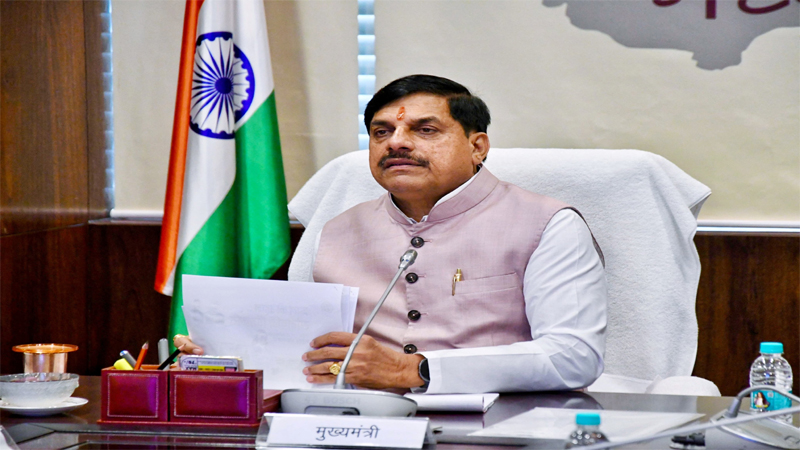
This is perhaps the phase that Madhya Pradesh Chief Minister Dr. Mohan Yadav is currently navigating.
When the Bharatiya Janata Party unexpectedly chose Dr. Yadav to lead Madhya Pradesh in December 2023, many political observers viewed the decision as a bold organisational experiment. Less than three years later, the political landscape appears significantly different. Dr. Yadav has emerged not merely as the Chief Minister of Madhya Pradesh but as one of the BJP’s prominent campaigners in several Assembly elections across states including Delhi, Haryana, Maharashtra, Bihar and West Bengal.
His growing visibility, particularly among OBC and Yadav communities, reflects the BJP’s broader social outreach strategy. Whether this expansion can be measured solely in electoral terms is a matter of political debate. However, there is little doubt that the party increasingly views him as a leader with significance beyond Madhya Pradesh.
And that is precisely where a new political reality begins.
Leaders who acquire wider political relevance invariably attract greater public scrutiny. Their administrative decisions, financial disclosures, family businesses and even routine political activities become subjects of national discussion. This is neither unusual nor necessarily unfair. It is an inevitable consequence of democratic politics.
The recent controversy surrounding media reports on land-related issues involving the Chief Minister illustrates this phenomenon. The opposition raised questions, the ruling party rejected the allegations, and political debate intensified. Such exchanges are part of democratic accountability.
However, the most significant lesson from this episode lies elsewhere.
The issue, in my view, was not merely the allegations themselves but the communication vacuum that followed.
In today’s political environment, perception often travels faster than documentation. News cycles move within minutes, social media amplifies narratives instantly, and political interpretations are formed long before official clarifications arrive. Once a narrative gains public traction, even factual rebuttals struggle to achieve the same impact.
This is where political communication becomes as important as governance itself.
Dr. Mohan Yadav has undoubtedly focused considerable attention on governance, investment promotion, infrastructure development and administrative reforms. Yet the recent episode suggests that his political communication ecosystem may not have evolved at the same pace as his expanding political stature.
Every successful political leader eventually requires more than an efficient administrative machinery. Equally essential is a trusted ecosystem comprising political advisers, legal experts, communication professionals and rapid-response teams capable of presenting verified facts before speculation dominates public discourse.
Modern politics is no longer fought only through policies.
It is equally contested through narratives.
Silence, regardless of intent, often creates avoidable speculation. A timely factual response, on the other hand, strengthens institutional credibility. This is not merely a lesson for one Chief Minister but for governments across party lines.
Opposition parties are expected to question governments. The media is expected to investigate public office. These are indispensable features of democracy. But governments, too, carry an equally important responsibility—to communicate transparently, promptly and confidently.
Political legitimacy today depends not only on administrative performance but also on public trust. And trust is reinforced through timely engagement with facts.
Dr. Mohan Yadav’s expanding national profile naturally places him under greater political observation. Such scrutiny should perhaps be viewed not as a political setback but as evidence of increasing relevance. The larger the leadership role, the higher the standards of accountability.
The real challenge before him, therefore, may not be the opposition alone.
It may well be whether his political and communication architecture is sufficiently prepared for the demands of national-level politics.
History repeatedly demonstrates that rising leaders are judged not merely by the allegations they face but by the confidence, transparency and institutional maturity with which they respond to them.
In contemporary politics, governance and communication are no longer parallel functions.
They have become inseparable.
For Dr. Mohan Yadav, strengthening this second pillar may prove just as important as strengthening the first.
Because in politics, facts ultimately matter—but the timing of those facts often matters just as much.