
‘Delhi Declaration’ Unveiled at WHO Summit: Beginning of a New Era in Integrative Medicine
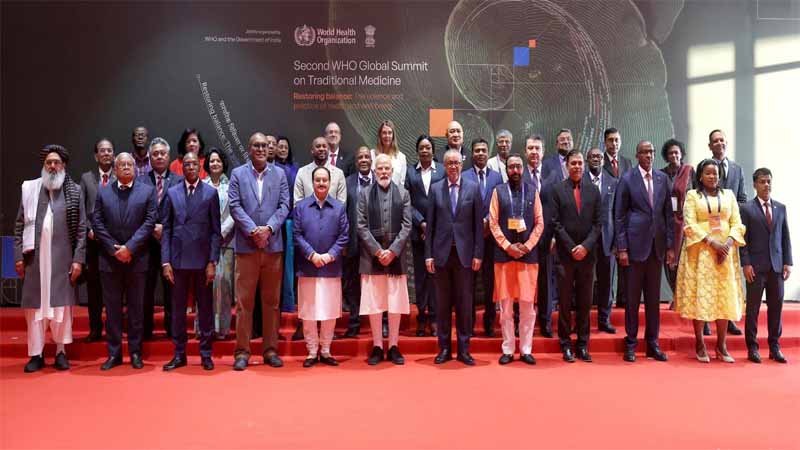
New Delhi : The release of the “Delhi Declaration” at the second Global Summit on Traditional Medicine of the World Health Organization (WHO) has marked the beginning of a new chapter in integrative medicine. The declaration emphasizes the integration of traditional medicine into national health systems—particularly primary health care—in a safe, effective, and evidence-based manner, with the objective of advancing Universal Health Coverage (UHC).
The summit was jointly organised by the Ministry of AYUSH, Government of India, and the World Health Organization from December 17 to 19 at Bharat Mandapam, New Delhi, under the theme “Restoring Balance: The Science and Practice of Health and Well-being.” The Delhi Declaration was unveiled in the presence of Prime Minister Shri Narendra Modi, WHO Director-General Dr Tedros Adhanom Ghebreyesus, Union Minister for Health and Family Welfare Shri Jagat Prakash Nadda, and Union Minister of AYUSH Shri Prataprao Jadhav.
The declaration is the outcome of collective efforts by health policymakers, experts, researchers, and stakeholders from traditional medicine systems across more than 100 countries. Its core objective is to strengthen collaboration between traditional and modern medicine and to promote a globally accepted, evidence-based integrative health model.
Prime Minister Modi: Perception of Traditional Medicine Has Changed
Addressing the closing ceremony, Prime Minister Narendra Modi said that traditional medicine was earlier perceived as being limited to wellness or lifestyle care, but this mindset is rapidly changing. He noted that traditional medicine can play an effective role even in critical medical situations.
The Prime Minister also highlighted a joint initiative by the Ministry of AYUSH and the WHO Traditional Medicine Centre to strengthen integrative cancer care in India, which will help develop evidence-based clinical guidelines.
WHO Appreciates India’s Efforts
WHO Director-General Dr Tedros praised India’s leadership, stating that the establishment of the Ministry of AYUSH and the Global Traditional Medicine Centre has demonstrated to the world that modern medical science and traditional medicine are not rivals, but complementary systems.
Four Key Pillars of the Delhi Declaration
The Delhi Declaration is built on four major pillars:
Strengthening evidence-based knowledge: Promoting rigorous, ethical, and multidisciplinary research in traditional medicine.
Ensuring safety, quality, and public trust: Establishing clear, reliable, and risk-based standards for products, practices, and practitioners.
Integration into health systems: Incorporating traditional medicine into national health systems, especially at the primary health care level.
Responsible use of innovation and digital technologies: Leveraging AI, data science, and genomics to enhance research, data access, and global knowledge sharing.
India’s Leadership Role
Union Minister of AYUSH Shri Prataprao Jadhav described the Delhi Declaration as a global roadmap for traditional medicine, while AYUSH Secretary Vaidya Rajesh Kotecha termed it a shared commitment towards strengthening research, standardisation, capacity building, and international cooperation.
The Road Ahead
Building upon the Gujarat Declaration adopted at the first Global Summit on Traditional Medicine in 2022, the Delhi Declaration highlights the growing scientific evidence base, innovation potential, and ability of traditional medicine to address emerging health challenges.
The declaration sends a clear message that future health systems will be based not on competition, but on collaboration—where tradition and modern science come together to advance human well-being.