
Arunachal Pradesh Seeks Special Policy Support at NITI Aayog Meeting, CM Pema Khandu Highlights Strategic and Developmental Priorities
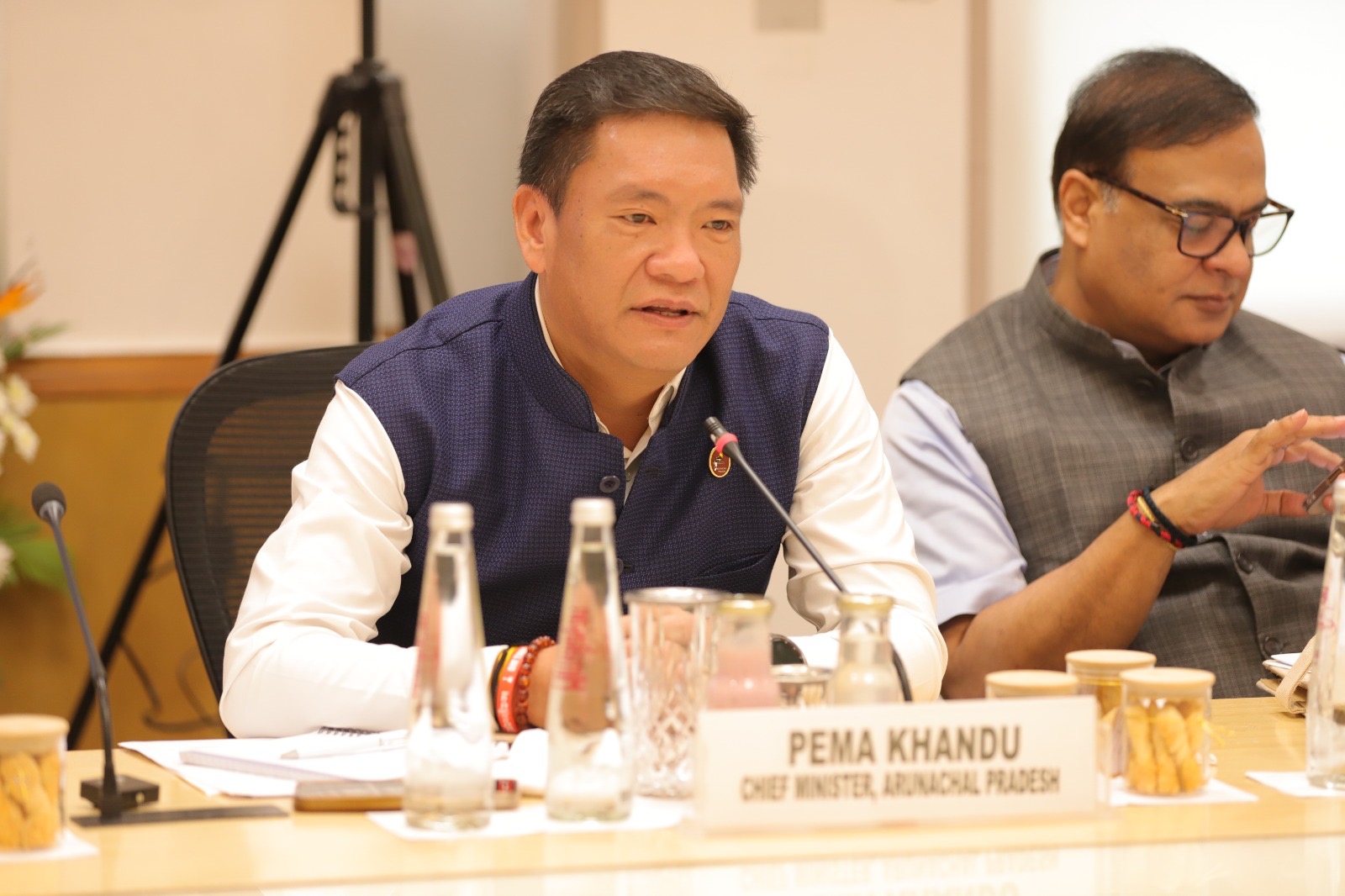
New Delhi : Arunachal Pradesh Chief Minister Pema Khandu participated in a high-level interaction with the Chief Ministers of the North Eastern States convened by NITI Aayog, where he strongly advocated for special policy interventions and enhanced support mechanisms to address the state’s unique developmental and strategic challenges.
Addressing the meeting, Khandu expressed gratitude to Prime Minister Narendra Modi for his unwavering support to the North East and for implementing the Act East Policy in both letter and spirit. He said the Prime Minister’s vision has transformed connectivity, infrastructure and public confidence across the region, creating new opportunities for inclusive growth and development.
Highlighting Arunachal Pradesh’s vast geographical expanse and strategic importance, Khandu stressed the need for dedicated infrastructure support to overcome challenges posed by difficult terrain and scattered settlements. He noted that despite being the largest state in the North East by area, Arunachal Pradesh continues to face unique developmental constraints that require special consideration.
Focus on Hydropower and Employment Generation
The Chief Minister informed the meeting that Arunachal Pradesh has set an ambitious target of generating 40,000 MW of hydropower by 2047. He sought coordinated support from NITI Aayog and relevant ministries to sustainably harness the state’s vast hydropower potential.
Khandu emphasized the importance of skill development for local youth and the promotion of ancillary industries to maximize employment opportunities and ensure local communities benefit from ongoing and upcoming hydropower projects.
Call for Review of Funding Criteria
Drawing attention to funding challenges faced by sparsely populated but geographically large states, Khandu called for an urgent review of population-based funding criteria. He argued that existing allocation mechanisms often place Arunachal Pradesh at a disadvantage despite its strategic importance, difficult terrain and large geographical area.
He urged NITI Aayog to develop alternative funding parameters that better reflect ground realities and developmental needs.
Rural Connectivity and Border Development
On rural connectivity, the Chief Minister advocated expanding the Pradhan Mantri Gram Sadak Yojana (PMGSY) to include unconnected villages with populations of 250 and above.
While appreciating the success of the Vibrant Villages Programme in strengthening border infrastructure and livelihoods, he noted that several villages still remain disconnected due to lack of road access and require focused intervention.
Khandu also highlighted that Arunachal Pradesh has not benefited from externally aided projects to the same extent as several other North Eastern states and requested NITI Aayog to explore mechanisms to bridge this gap and accelerate development activities.
Institutional and Governance Reforms
Seeking support for policy innovation and governance reforms, Khandu informed the gathering about the establishment of the Institute of Transforming Arunachal and requested NITI Aayog’s guidance in developing it into a premier policy and governance think tank for the state.
He also showcased innovative governance initiatives such as Sarkar Aapke Dwar, Seva Aapke Dwar, and Cabinet Aapke Dwar, which have significantly improved citizen outreach by delivering government services directly to remote villages.
On administrative reforms, the Chief Minister strongly advocated the creation of a separate All India Services cadre for Arunachal Pradesh. He observed that the current arrangement often results in frequent transfers of officers, affecting policy continuity and institutional capacity building.
In this regard, he proposed a joint cadre arrangement with Mizoram, a suggestion that received support from Mizoram Chief Minister.
Digital Governance and Regional Planning
Khandu informed the meeting that Arunachal Pradesh has successfully implemented E-Vidhan and E-Office systems, with the E-Office platform now being expanded to the district level to enhance transparency, accountability and efficiency in governance.
In a significant proposal aimed at strengthening regional planning, he suggested that the North Eastern Council (NEC) be empowered to function as the “NITI Aayog of the North East.” He emphasized that given the region’s strategic location and shared international borders, the NEC should play a larger role in addressing region-specific challenges and coordinating development priorities.
Support from NITI Aayog and Other States
During the interaction, the Vice Chairman of NITI Aayog appreciated the diversity and uniqueness of Arunachal Pradesh’s human capital and suggested strengthening Industrial Training Institutes (ITIs) through partnerships with major hydropower companies. He also assured support in taking up the state’s concerns with relevant ministries.
Assam Chief Minister Himanta Biswa Sarma praised Arunachal Pradesh’s progressive hydropower policies and emphasized the importance of developing effective mechanisms for the sustainable utilization of natural resources.
The deliberations reflected the collective commitment of the North Eastern States toward accelerating development, improving connectivity and harnessing both natural and human resources for long-term prosperity.
Reaffirming Arunachal Pradesh’s commitment to cooperative federalism, Chief Minister Pema Khandu stated that the state would continue to work closely with NITI Aayog, the North Eastern Council and the Government of India to transform challenges into opportunities and ensure inclusive and sustainable development for its people.