Maatrutva is the fundamental basis for the growth, nourishment and continuity of creation: Dr. Mohan Bhagwat
Rakesh Thapliyal
New Delhi: Rashtriya Swayamsevak Sangh Sarsanghchalak Dr Mohan Bhagwat said that Speaking on the subject of Maatrutva (motherhood) itself is, in a way, a contradiction for me. In one sense, this is a domain that rightly belongs to women, and it is not quite proper for men to speak on it. On this subject, Vishwamanglya Sabha has already conducted extensive deliberations, and from earlier times there has been deep reflection on what our perspective is, what our tradition says, and how to conduct ourselves in today’s age. Thinkers like Swami Vivekananda ji, Mahatma Gandhi ji, and Rabindranath Tagore ji have all reflected comprehensively on these questions and placed their thoughts before us.
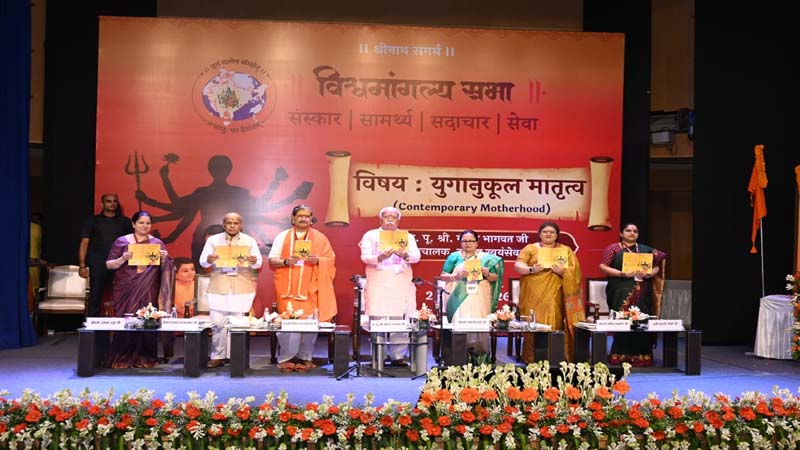
Dr. Bhagwat was addressing the valedictory session of the awareness meeting organised by Vishwamanglya Sabha on the theme “Yuganukool Maatrutva (motherhood in harmony with the times)” on Friday evening here at Ambedkar International Centre.
The theme given for this programme is Yuganukool Maatrutva. The eternal aspects of Maatrutva remain the same; they do not change according to the age. Because of these very eternal aspects, those who bring about change in an era actually emerge. Since the beginning of creation, the world has functioned on the foundation of Maatrutva. Whenever any living being comes into existence, Maatrutva is inherently present; there is always a mother. The creation, sustenance, and nourishment of the world are not possible without Maatrutva. Maatrutva is the fundamental basis for the growth, nourishment, and continuity of creation. The greatest strength of a human being is his thought, but it is the mother who gives that thought the right direction. The mother is the first guru of a human being and remains the foremost centre of emotional support throughout his life.
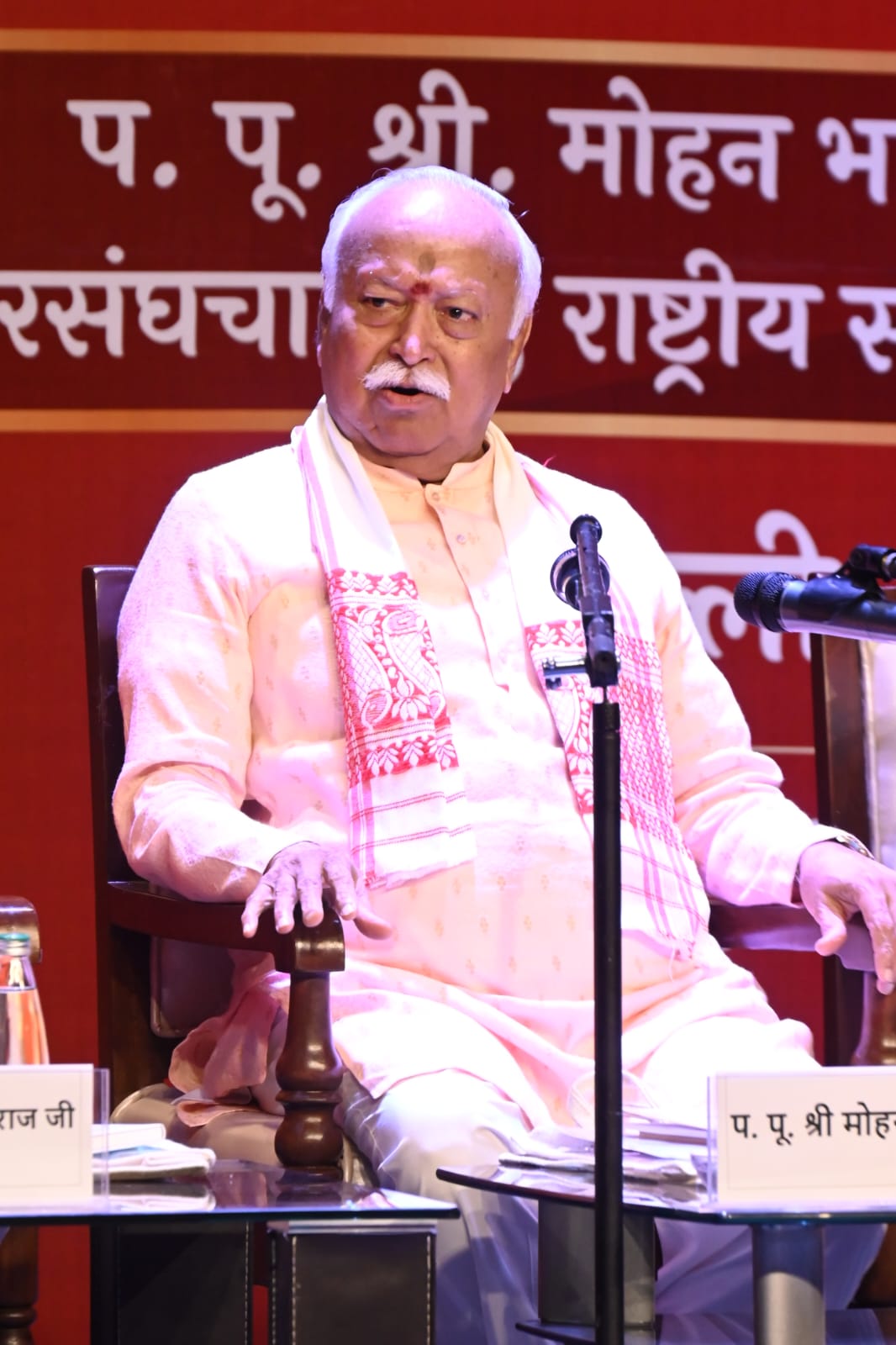
He said that, today, the greatest need in families is to give time and to maintain constant dialogue. It is the responsibility of parents to respond to and resolve the curiosities of their children, for which it is essential that they themselves continuously expand their own knowledge. Children learn more by imitation than by instruction, so parents must themselves present an ideal standard of conduct.
He said that many debates in society arise out of confusion, and at times confusion is even deliberately created. For a long period, misconceptions were spread about Bharatiya culture as well, suggesting that our traditions are wrong, whereas the reality is that our cultural foundations are extremely strong and evident. We should move forward with confidence in our history, our knowledge, and our traditions.
He said that unity alone is the ultimate truth, and that a sense of oneness amidst diversity is the core message of Bharatiya culture. While living in Bharat, one should live a life in accordance with Bharatiya culture and life-values. Rather than unthinkingly adopting the lifestyles of other countries, it is the need of the hour to strengthen our social and family structures on the basis of the Bharatiya perspective.
The national awareness meeting for North India was organised by the global women’s organisation Vishwamanglya Sabha, which works with the motto “Maatru Nirman se Rashtra Nirman (Nation-building through Mother-building)”, and concluded on 23–24 July at the Vishva Yuvak Kendra.
Around 280 women from various states participated in this two-day meeting.
The central theme of the meeting was “Yuganukool Maatrutva under which extensive reflection and dialogue took place on the changing social milieu, the Indian family system, and the contemporary role of motherhood.
In the valedictory session of the awareness meeting, more than 900 eminent Matrushakti (women as embodiments of maternal power) working in diverse fields were present.
For the dialogue organised on the theme “Yuganukool Maatrutva”, approximately 2,000 to 2,500 women had registered.
In the year 2026, Vishwamanglya Sabha organised adhiveshan (conventions) in 23 prants (provinces) of the country, in which around 37,000 women participated.
In these adhiveshan, special discussions were held on the Indian family system, the changing role of motherhood, and the value-based upbringing (sanskar nirman) of coming generations.
At present, Vishwamanglya Sabha is active in 33 prants of Bharat, and about 6 lakh Matrushakti are associated with the organisation, working in various areas such as education, sanskar (value inculcation), social awakening, and seva (service).
Beyond Bharat, the organisation’s activities extend to 14 countries, including the United States of America and the Netherlands.
Vishwamanglya Sabha believes that every woman is an embodiment of that Maatrutva (motherhood) shakti which forms the foundation for the building of family, society, and nation.
The organisation’s objective is to develop in women a sense of duty towards Maatrutva, cultural consciousness, moral values, and leadership capacity so that, through the creation of well-sanskarit (value-oriented) generations, they may play an active role in building a strong, harmonious, and self-confident Bharat.
Vishwamanglya Sabha was established on 19 February 2010 in Nagpur under the guidance of Param Pujya Acharya Swami Shri Jitendranath ji Maharaj.
He is the 18th Peethadheeshwar (head of the Peeth) of the more than 600-year-old Shri Datt Peeth tradition.Working on the fourfold principles of sanskar (value inculcation), samarthya (capability), sadachar (righteous conduct), and seva (service), the organisation is mobilising Matrushakti to carry forward the campaign of nation-building.