
Lok Sabha Records 19% Productivity, But Not Its Worst; Only 5% of Scheduled Time Was Utilised in 2010
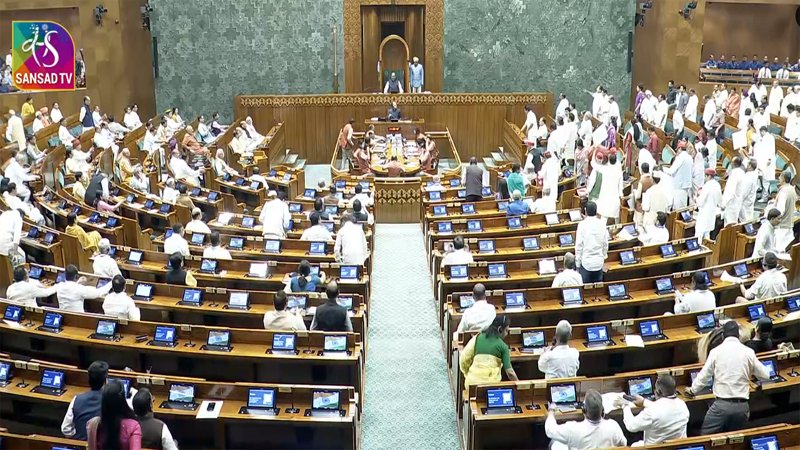
New Delhi: The Monsoon Session of Parliament concluded amid disruptions, protests and heated exchanges between the government and the Opposition. After the session ended, Parliamentary Affairs Minister Kiren Rijiju told the media that the Lok Sabha recorded only 19% productivity, while the Rajya Sabha recorded 39%.
Rijiju accused the Opposition of repeatedly disrupting proceedings, saying that the government wanted Parliament to function but the Opposition continued to create disruptions.
Although the Lok Sabha’s performance during the Monsoon Session was poor, available data shows that it was not the least productive session in Parliament’s recent history.
According to a report by The Indian Express, data on parliamentary sessions since 2009 shows several instances when the productivity of both the Lok Sabha and Rajya Sabha was lower than in the current session. The worst performance was recorded during the Winter Session of December 2010, when the Lok Sabha functioned for only 5% of its scheduled time, while the Rajya Sabha worked for just 2%.
The figures are based on data compiled by PRS Legislative Research.
2G Spectrum Row Had Brought Parliament to a Standstill
The Winter Session of 2010 was almost entirely lost to disruptions. The Opposition demanded the formation of a Joint Parliamentary Committee (JPC) to investigate alleged irregularities in the allocation of 2G spectrum.
The then government, however, maintained that the matter could also be examined by the Public Accounts Committee (PAC). With neither side willing to concede ground, the deadlock continued and much of the session passed without substantive legislative business.
Lok Sabha Functioned for Only 6% in 2013
The Winter Session of 2013 was also severely affected by disruptions. The Opposition targeted the government over the findings of the JPC related to telecom licence allocation.
At the same time, MPs from Andhra Pradesh protested over the proposed formation of Telangana. The condition of people displaced after the Muzaffarnagar riots also became a source of heated debate and disruption in Parliament.
During the session, the Lok Sabha functioned for only 6% of its scheduled time.
Parliament Also Faced Disruptions During the Modi Government
Several sessions of Parliament have also been disrupted during the tenure of the Narendra Modi government.
During the 2015 Monsoon Session, Lok Sabha productivity stood at 46%, while Rajya Sabha productivity was only 9%. The Opposition targeted the government over the controversy involving then External Affairs Minister Sushma Swaraj and the Lalit Modi issue, as well as the Vyapam scam in Madhya Pradesh.
During the session, 25 of the Congress party’s 44 MPs were suspended for five days. Several Opposition parties subsequently boycotted parliamentary proceedings in protest.
The following year, the 2016 Winter Session was also badly affected by Opposition protests over demonetisation. The Lok Sabha functioned for only 15% of its scheduled time, while the Rajya Sabha recorded 18% productivity.
It was regarded as one of the least productive Lok Sabha sessions during the NDA government’s tenure.
Low Productivity Raises Questions Over Parliamentary Functioning
The current Monsoon Session, with Lok Sabha productivity at just 19%, has once again raised concerns over the functioning of Parliament. Disruptions not only result in the loss of valuable parliamentary time but can also limit detailed debate on legislation and issues of public importance.
At the same time, historical data makes it clear that disruptions in Parliament are not a new phenomenon. Different governments and Opposition parties have witnessed prolonged disruptions over major political and national issues.
The latest figures therefore underline the need for a broader discussion on ensuring that Parliament remains a forum for meaningful debate, legislative scrutiny and democratic accountability, even amid political disagreements.