
$136.5-bn India – EU trade: Govt plans time-bound finality for arbitral awards, says Secretary, Legislative Department and Legal Affairs
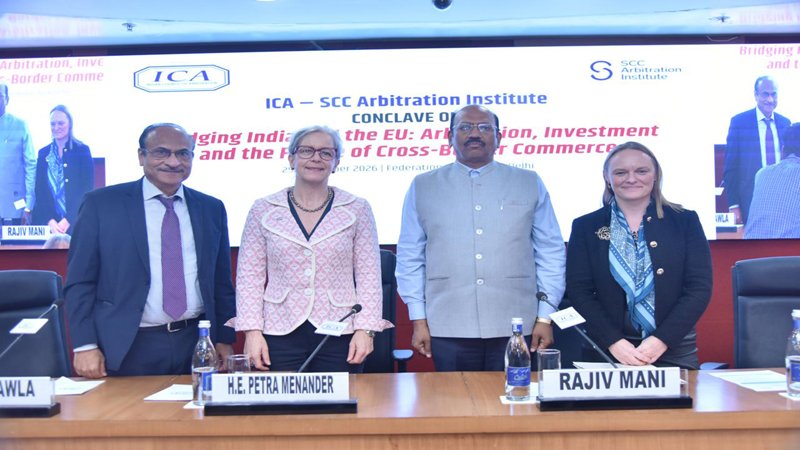
New Delhi: The Government of India is proposing further amendments to ensure challenges to arbitral awards and the execution of decrees are resolved in a time-bound manner, Dr Rajiv Mani, Secretary, Legislative Department and Department of Legal Affairs, Ministry of Law and Justice, said on Wednesday evening.
Addressing the ICA–SCC Arbitration Institute Conclave on “Bridging India and the EU: Arbitration, Investment and the Future of Cross-Border Commerce” at Federation House, New Delhi, Dr Mani noted that negotiations on an India-EU Investment Protection Agreement are continuing with an early conclusion in view.
“Besides the enactment of the Commercial Courts Act of 2015, we are also proposing to introduce further amendments so that the finality of an arbitral award, when challenged under the applicable law and the provisions of the Arbitration and Conciliation Act, 1996, is resolved within a time-bound manner, and the execution of the decree takes place, of course, in a time-bound manner,” Dr Mani said.
In her special address, H.E. Petra Menander, Ambassador of Sweden to India, noted that Sweden and India aim to double their economic exchange by 2030. “Dispute resolution enables business. Building trust and lowering the perception of risk when you have partners who are quite far away is absolutely essential,” she said.
Highlighting the Mediation Act, 2023, Dr Mani emphasized that multi-tiered dispute resolution clauses and pre-institution mediation can help businesses avoid prolonged litigation. “Arbitration and mediation, in my view, should not be viewed as competing mechanisms. While arbitration provides an adjudicatory mechanism resulting in a binding determination, mediation offers parties an opportunity to resolve disputes in a consensual and amicable manner while preserving the commercial relationship,” he added.
Welcoming the conclusion of India-EU FTA negotiations likely to be signed “perhaps this year itself” Dr Mani stressed expanding affordable arbitration into Tier-2 and Tier-3 cities for smaller enterprises. “Given India’s rise and its ambition of becoming a $7 trillion economy by 2030 a partnership of trust between India and the European Union would go a long way in strengthening overall international investment and cross-border commerce, benefiting everyone,” he said.
Delivering the opening address, Mr Arun Chawla, Director General, ICA, announced the renewal of a 1987 cooperation agreement between ICA and the SCC. Citing US$136.5 billion in India-EU merchandise trade in 2024–25 and preferential access for 99.5% of Indian
exports under the upcoming FTA, he said: “A Free Trade Agreement may reduce the cost of doing business, while an effective dispute resolution system reduces the risk of doing business. For businesses to take full advantage of market access, both are essential.”
In her closing remarks, Ms Caroline Falconer, Secretary General, SCC Arbitration Institute, shared that SCC arbitrations typically conclude within a year, with Indian parties appearing annually. “It is really time to get ready, because we are seeing great interest from Swedish parties, Swedish companies, and European companies in India,” she said.
The conclave also included a strategic dialogue moderated by Mr Sanjeev Kapoor (Khaitan & Co), featuring Ms Falconer, Mr Niclas Widjeskog (CMS Wistrand), Mr Benjamin Wells (Belgravia Law), and Dr Sanjeev Gemawat (Essar Group).