
NUJI Should Prepare Action Plan to Tackle Fake News and Submit It to Government: Vasudev Devnani
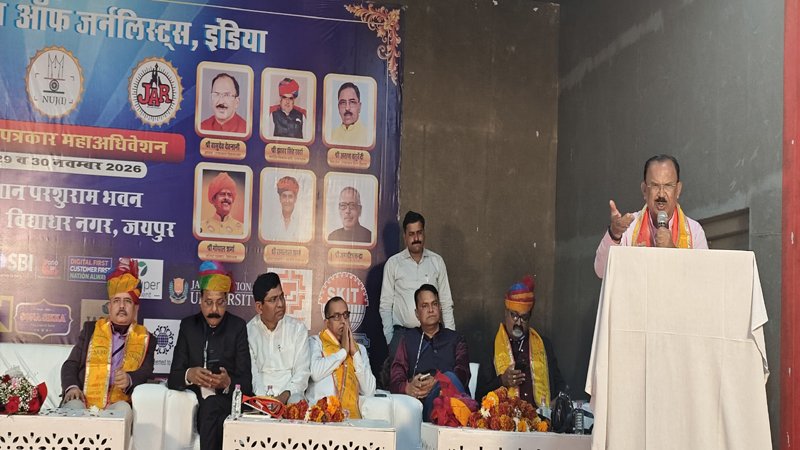
Jaipur: Rajasthan Legislative Assembly Speaker Dr. Vasudev Devnani has described fake news and the growing trend of people declaring themselves journalists on social media without any credentials as major challenges facing journalism today. He urged the National Union of Journalists (India) (NUJI) to prepare a concrete action plan to tackle fake news and submit it to the government so that it can be implemented effectively based on journalists’ recommendations.
Addressing the inaugural session of NUJI’s national convention as the chief guest on Sunday morning at Parshuram Bhawan, Sector 4, Jaipur, Dr. Devnani also invited journalists from across the country to visit the Rajasthan Legislative Assembly.
He said that journalism and the country are going through a challenging phase. While genuine journalists are struggling, people making baseless statements for a minute of publicity are grabbing headlines. In contrast, those presenting serious issues with facts and dignity often receive very little space.
Respect for Constitutional Institutions and ‘Nation First’ Essential
Devnani said Indian democracy faces no threat and journalists have a responsibility to strengthen it further. While disagreement is an integral part of democracy, growing disrespect towards constitutional institutions is a matter of concern.
He urged journalists to adopt the spirit of ‘Nation First’ and write analytical articles that not only highlight problems but also suggest solutions.
On the Journalist Protection Act, he said the government was considering the issue. However, he also stressed the need for media organisations to implement government schemes and prescribed salary structures for journalists. He called upon journalist organisations to develop a transparent mechanism to facilitate government support.
Authenticity and Recognition of Accredited Journalists Must Be Ensured: Jagdish Chandra
Addressing the convention, Bharat 24 Chairman and Editor-in-Chief Jagdish Chandra emphasised the importance of media credibility and respect for genuine journalists.
He said journalism should remain open to newcomers and fresh ideas, but ensuring the authentic identity and proper recognition of institutional and authorised journalists is equally important.
Expressing concern over the growing number of people carrying press identity cards without being regularly involved in journalism, he said the objective was not to prevent anyone from entering the profession but to ensure that journalists associated with recognised media organisations receive due priority and dignity.
He appreciated NUJI for raising the issue at the national level and assured that responsible media organisations would support the initiative and help spread awareness about the challenges facing genuine journalism.
Irresponsible Social Media Statements Are Not Journalism: MLA Gopal Sharma
Civil Lines MLA Gopal Sharma, who attended the inaugural session as a special guest, expressed concern over irresponsible journalism in the name of social media.
He said that making statements without facts, research or social responsibility cannot be considered journalism. Such practices damage the credibility of the profession and mislead society.
He emphasised that journalism must uphold dignity, sensitivity, impartiality and responsibility. Its purpose should not be limited to sensationalism but must include guiding society in the right direction and raising issues of public interest.
He appreciated NUJI’s efforts to restore the ethical values and dignity of journalism.
Journalists Should Establish Their Identity Through Their Writing: Rakesh Thapliyal
NUJI National President Rakesh Thapliyal highlighted the struggles faced by journalists and said they should establish their identity among the public through the strength of their writing.
He urged the Central and State Governments to address issues concerning journalists’ safety, social security, pensions and dignified salary structures without delay.
Fake Press Cards Being Sold for Rs 250; National Register Needed: Raas Bihari
Senior journalist Raas Bihari called for strict action against fake journalists and fraudulent organisations to protect the credibility of journalism.
He expressed concern over advertisements on social media offering press cards for prices ranging from Rs 250 to Rs 1,799, without requiring professional experience or affiliation with any media organisation.
Referring to incidents during protests in Delhi, where alleged fake journalists reportedly misbehaved with mainstream media professionals and FIRs were registered, he called for a structured national register of journalists, similar to those maintained for advocates and medical professionals.
He also stressed the need to distinguish genuine journalists from paid influencers operating with political agendas.
Senior Journalists Honoured
During the convention, distinguished guests felicitated senior journalists including Om Chaturvedi, Dilip Bhati, Shiv Charan Sharma (Bikaner), Ramji Lal Sharma, Syed Munawwar Ali, Pink City Press Club’s former president Virendra Singh Rathore (Billu Bana), Rohit Soni of Dainik Navjyoti, newly elected NUJI National President Rakesh Thapliyal, General Secretary Rakesh Kumar Sharma, Treasurer Ramchandra Kannojia, former national president Raas Bihari and former general secretary Pradeep Tiwari.
JAR Rajasthan Welcomes Delegates
The convention was hosted by JAR Rajasthan. Under the leadership of State Convenor and NUJI National General Secretary Rakesh Sharma, state president Sanjay Saini, state general secretary Suresh Pareek, state treasurer Kaushal Mundra, state organisation secretary Bhanwar Singh Kushwaha and state vice-president Vivek Vaishnav welcomed the guests with traditional turbans and mementoes.
The proceedings were conducted by JAR State Vice-President Manimala Sharma.
Resolution on Journalist Protection Act Passed
During the convention, Joginder Dev Arya, President of the Himachal Pradesh Union of Journalists, moved a proposal seeking the implementation of a Journalist Protection Act at the national level. The proposal was unanimously adopted.
The convention discussed the need for central legislation to protect journalists against attacks, threats and false cases. It also proposed the formation of journalist safety committees at the national, state and district levels.
Amendments to the union’s constitution were also discussed and approved.