
Arunachal Govt to Work with Stakeholders on Indigenous Rights, ILP and Demographic Concerns: CM Pema Khandu
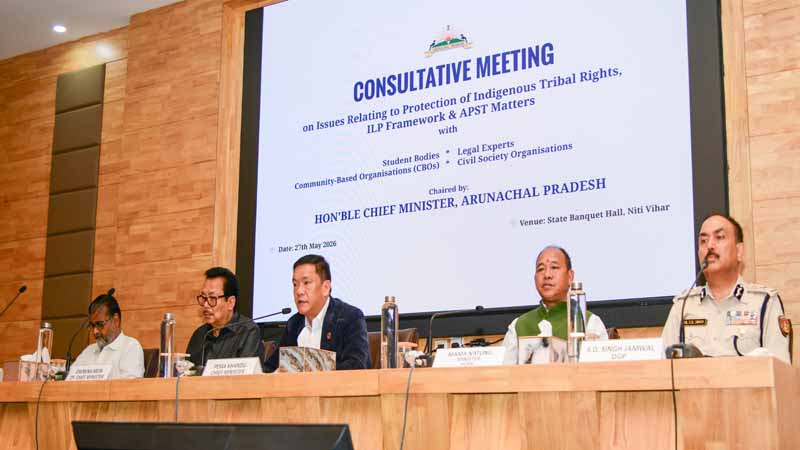
Itanagar: Arunachal Pradesh Chief Minister Pema Khandu has assured that the State Government will work collectively with all stakeholders to formulate concrete and long-term solutions on issues related to indigenous tribal rights, demographic concerns, regulation of the Inner Line Permit (ILP) system, and APST-related matters.
Addressing a high-level consultative meeting held at the State Banquet Hall in Niti Vihar, the Chief Minister described the deliberations as “historic,” noting that representatives from community-based organisations (CBOs), student bodies, legal experts, civil society groups, political parties, and senior government officials participated in the discussions.
The marathon meeting, which lasted nearly seven-and-a-half hours without interruption, witnessed participation from the Arunachal Indigenous Tribes Forum (AITF), the All Arunachal Pradesh Students’ Union (AAPSU), the ST Bachao Andolan Committee (STBAC), political leaders, and officials from the Home, Law, Political, and Indigenous Affairs departments.
Khandu expressed gratitude to the ST Bachao Andolan Committee for drawing the government’s attention to what he termed a “long-burning issue” that has remained unresolved despite repeated discussions over the years. He emphasized that the concerns raised are not unique to Arunachal Pradesh but are part of a broader national challenge involving illegal immigration, demographic shifts, and threats to indigenous identity and cultural preservation.
Referring to Prime Minister Narendra Modi’s Independence Day address from the Red Fort on August 15, 2025, the Chief Minister said the Union Government has already identified demographic imbalance and illegal immigration as serious concerns affecting law and order, indigenous culture, and national security.
He also informed participants that Union Home Minister Amit Shah recently notified a national-level High-Level Committee on Demographic Change comprising a retired judge, former IAS and IPS officers, and senior officials from the Ministry of Home Affairs, indicating that the issue is receiving significant attention at the national level.
Government Accepts Key Demands in Principle
The Chief Minister stated that the State Government has, in principle, accepted four major demands raised during the meeting. Among them is the long-pending demand for the creation of a dedicated department to manage and regulate the Inner Line Permit (ILP) system under the Bengal Eastern Frontier Regulation (BEFR).
Announcing the government’s in-principle approval for a separate ILP Department, Khandu noted that the proposal had consistently been advocated by both AAPSU and STBAC.
He also acknowledged concerns over demographic changes and their impact on the culture, traditions, and identity of indigenous tribal communities, stressing that preserving Arunachal Pradesh’s unique heritage is a shared responsibility.
Focus on Skill Development and Self-Reliance
Highlighting the need for long-term solutions, the Chief Minister strongly advocated skill development and capacity-building initiatives for local youth to reduce dependence on external labour.
Drawing a comparison with Mizoram, he underlined the importance of vocational training and dignity of labour. He cited the example of a group of tribal youths from Arunachal Pradesh who underwent specialized plumbing and electrical training in Bengaluru. After returning, they successfully completed a project in Pasighat worth ₹10 lakh, while external contractors had quoted ₹18 lakh for the same work, resulting in savings of ₹8 lakh and creating local employment opportunities.
Khandu urged apex community-based organisations to actively promote skill development programmes and encourage greater participation among tribal youth.
High-Level Committee to Chart the Way Forward
As a major outcome of the meeting, the Chief Minister announced the formation of a high-level committee to further deliberate on the issues discussed and recommend a roadmap for future action.
He said a follow-up meeting would be held on May 29, 2026, for the formal constitution of the committee. Seven members each from AITF, AAPSU and STBAC, along with two to three representatives from the legal fraternity, have been invited to participate in the process.
The government will officially notify the committee after finalizing its membership. Khandu assured stakeholders that all recommendations submitted by the committee would be discussed transparently and collectively before any final policy decisions are taken.
Reiterating the spirit of “Team Arunachal,” the Chief Minister called upon all stakeholders to work together in safeguarding indigenous rights, strengthening governance, and ensuring the long-term development, stability, and cultural preservation of Arunachal Pradesh.