
Home Ministry Working with Supreme Court and High Courts to Prepare Blueprint for Reducing Pending Cases: Amit Shah
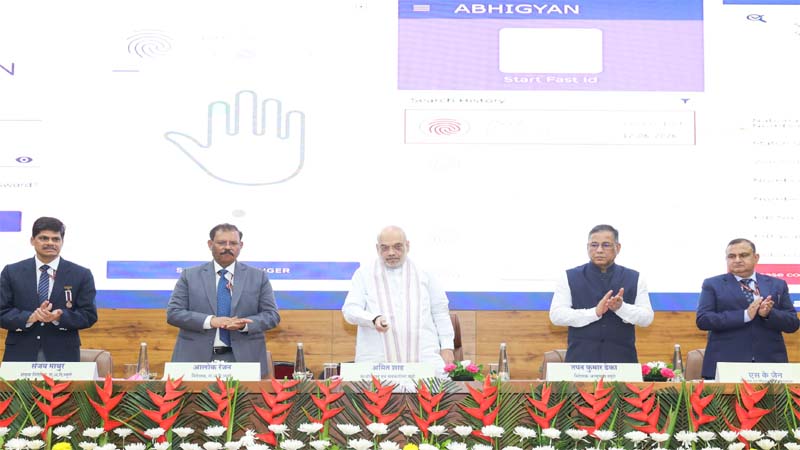
New Delhi: Union Home and Cooperation Minister Amit Shah on Friday said that the Ministry of Home Affairs is working closely with the Supreme Court and various High Courts to develop a comprehensive blueprint aimed at reducing the backlog of pending criminal cases and ensuring timely delivery of justice.
Addressing the inaugural session of the 26th All India Fingerprint Conference 2026 in New Delhi, Shah emphasized that India is currently passing through a crucial phase of transformation in its criminal justice system. He also launched several digital platforms, including NCRB-Abhigyan, CrPI, e-Prosecution 2.0, and e-Forensics 2.0, designed to strengthen the country’s justice delivery framework.
The event was attended by senior officials, including the Director of the Intelligence Bureau (IB), the Director of the National Crime Records Bureau (NCRB), and the Director of the Central Forensic Science Laboratory (CFSL).
Criminal Justice Reforms Enter a New Phase
Shah said the Modi government began a comprehensive overhaul of India’s criminal laws in August 2019 with the objective of modernizing the justice system and integrating advanced science and technology into every stage of criminal investigation and prosecution.
He reiterated that the government’s key goal is to ensure justice from the registration of an FIR to conviction within three years. According to Shah, India is now close to achieving this target through a coordinated effort involving police, prosecution agencies, forensic institutions, and the judiciary.
Scientific Evidence Key to Crime Control
Highlighting the importance of scientific investigation, Shah described forensic evidence as the most powerful tool in combating crime. He stressed that proper preservation and collection of evidence from crime scenes significantly improve conviction rates.
The Home Minister underscored the importance of fingerprint technology and the National Automated Fingerprint Identification System (NAFIS), stating that it has helped solve several complex criminal cases across the country.
He urged states not only to use NAFIS for identifying criminals but also to continuously enrich the database by uploading fingerprints collected from crime scenes.
“A criminal, no matter how clever, cannot escape the combined power of law and science,” Shah said.
Focus on Data Analytics and Artificial Intelligence
Shah called upon states to improve the quality, security, and utilization of criminal databases. He emphasized that merely storing data serves little purpose unless it is converted into actionable intelligence through modern technologies such as Artificial Intelligence (AI), Machine Learning, and Data Analytics.
He suggested the creation of specialized teams in every state to analyze crime patterns, identify repeat offenders, and profile interstate and international criminal networks.
“Data lying in cupboards cannot benefit anyone. Its real value emerges only when it is transformed into intelligence,” he remarked.
Massive Digital Infrastructure Established
The Home Minister highlighted the significant progress made in digitizing India’s criminal justice system:
- All 17,840 police stations in the country are now connected through the Crime and Criminal Tracking Network and Systems (CCTNS).
- More than 376.8 million FIR records and legacy data are available digitally.
- Around 22,000 courts have been integrated into the e-Courts system.
- The e-Prisons platform contains records of 22.9 million prisoners.
- The e-Forensics system holds data from 3.448 million forensic cases.
- The Cri-MAC platform has accumulated over 4.316 million alerts.
Shah said the challenge now is to use this vast repository of information effectively for crime prevention and investigation.
Blueprint to Reduce Judicial Pendency
Speaking on judicial reforms, Shah revealed that the Ministry of Home Affairs is preparing a roadmap in consultation with the Supreme Court and High Courts to address the issue of pending cases.
He said discussions are underway on establishing evening courts and introducing new mechanisms to accelerate the disposal of criminal cases in High Courts and the Supreme Court.
“The objective of the new criminal justice laws is clear: any crime registered anywhere in the country should complete the entire judicial process, including appeals up to the Supreme Court, within three years,” he said.
Training and Capacity Building
The Home Minister urged all state police forces to dedicate at least one day every week for training related to the new criminal laws, forensic procedures, and digital tools for the next year.
He emphasized that training should go beyond the use of apps and focus on generating scientific evidence, preparing concise charge sheets, and strengthening coordination among police, prosecution agencies, forensic experts, and courts.
NCRB’s Role Becoming More Significant
Praising the NCRB and the Bureau of Police Research and Development (BPR&D), Shah said both institutions have played a crucial role in implementing criminal justice reforms across the country.
He noted that NCRB is evolving from a record-keeping agency into an intelligence-driven institution focused on crime prevention and data-based policing.
Concluding his address, Shah said India’s future criminal justice system would be driven by technology, scientific evidence, integrated databases, and time-bound justice, ensuring stronger crime control and greater public confidence in the rule of law.