
Ram Mandir Management System Needs Complete Overhaul, Says Nripendra Misra
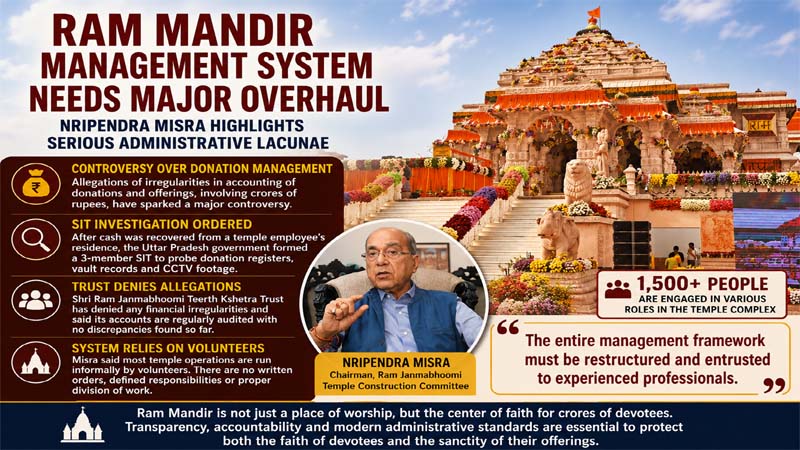
Ayodhya: Amid the controversy surrounding the alleged misuse of donations received at the Ram Mandir, Nripendra Misra, Chairman of the Ram Janmabhoomi Temple Construction Committee, has called for a comprehensive restructuring of the temple’s management system. He said the recent developments have exposed serious shortcomings in oversight, accountability, and administrative procedures.
Misra emphasized that the controversy is not limited to allegations of financial irregularities but has also highlighted weaknesses within the temple’s administrative framework. According to him, since the matter concerns the faith and trust of millions of devotees, the management structure must be made more transparent, accountable, and professionally managed.
“I have not formally submitted any proposal, but I have expressed my views publicly. My firm opinion is that the entire management framework should be reorganized and entrusted to experienced professionals,” Misra said.
Controversy Over Donation Management
The issue surfaced following allegations of irregularities in the accounting and management of donations and offerings received at the Ram Mandir. Reports suggested discrepancies involving crores of rupees, although these claims have not yet been officially verified.
The controversy intensified after reports emerged of cash being recovered from the residence of a temple employee, triggering political reactions. Subsequently, the Uttar Pradesh government constituted a three-member Special Investigation Team (SIT) to probe the matter. The SIT has been tasked with examining donation registers, vault records, and CCTV footage.
Trust Denies Any Wrongdoing
The Shri Ram Janmabhoomi Teerth Kshetra Trust has categorically denied any financial irregularities. The Trust maintains that its accounts are audited regularly and that no discrepancies have been detected so far.
Current System Relies Heavily on Volunteers
Speaking about the existing administrative arrangement, Misra said that much of the temple’s functioning currently depends on an informal volunteer-based system rather than a clearly defined institutional structure.
He noted that most individuals working at the temple are assigned responsibilities informally, with no written directives, clearly defined duties, or structured accountability mechanisms in place.
“Many activities are being carried out through traditional practices, but for an institution of this scale, an informal system alone is no longer sufficient,” he remarked.
Professional Management Essential for a Large Institution
According to Misra, nearly 1,500 people are engaged in various responsibilities within the temple complex. Such a large organization requires a well-defined administrative framework, clear chains of responsibility, and robust monitoring systems.
He pointed out that the Ram Mandir attracts millions of devotees from India and abroad and receives substantial donations. Therefore, institutionalizing financial management, security, record-keeping, and administrative procedures has become a necessity.
Safeguarding Both Faith and Accountability
The former IAS officer and former Principal Secretary to Prime Minister Narendra Modi said the recent controversy has raised serious questions about the systems designed to safeguard devotees’ offerings and donations.
He stressed that the Ram Mandir is not merely a religious site but a symbol of faith for millions of people. Consequently, transparency, accountability, and modern administrative standards must be integrated into its governance structure.
According to Misra, alongside the findings of the SIT investigation, there should be a comprehensive review of the temple’s administrative framework to prevent similar situations in the future.
His remarks are being viewed as a significant indication that structural reforms may be considered within the Ram Mandir administration. Attention is now focused on the SIT’s findings and the corrective measures that may follow.