
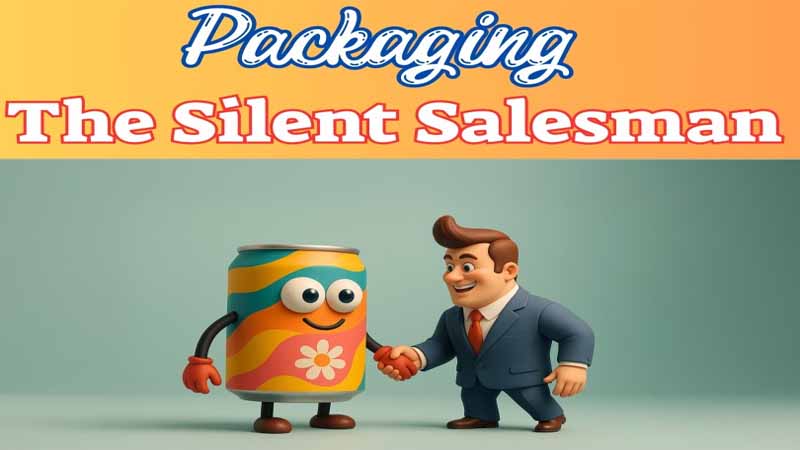
The Silent Shelf War: Why Packaging Is Becoming the Most Powerful Brand Medium
Shailesh Sheth
( Chairman & Managing Director, Kris Flexipacks)
There is a conversation that happens repeatedly in this industry. A brand invests significantly in product development, spends months on formulation, builds a distribution network, and then, somewhere near the end of the process, turns to packaging. The brief is typically functional: protect the product, carry the label, fit the line. Design gets two weeks and a limited budget.
That sequence is increasingly difficult to defend.
What the Shelf Actually Tells You
Spend time in a modern trade environment and watch how consumers move through an aisle. The interaction with most products lasts a few seconds at best. There is rarely any prior brand recall in play. The pack is doing all the work.
According to the POPAI Shopper Engagement Study, over 76 percent of buying decisions are made in-store at the point of sale. For many categories, the shelf moment is the only moment a brand gets. What the pack communicates in that window determines whether the product is picked up or passed over.
This is not a new observation. What has changed is the competitive intensity around it. As modern trade expands and product assortments deepen, the visual environment on shelf has become considerably more demanding. A pack that was adequate five years ago may now be invisible.
The Surface Area Opportunity
For much of packaging history, labels occupied a defined and limited portion of a container’s surface. The rest of the pack was, in effect, wasted space from a branding perspective. Newer label formats, particularly full-wrap and shrink sleeve applications, have changed what is possible.
When the entire container becomes a design surface, brands gain room to communicate more clearly, structure information more thoughtfully, and create a visual identity that holds up across different retail environments. This is not about filling space for its own sake. It is about using the available surface deliberately and in proportion to what the brand actually needs to say.
In categories where the product itself is difficult to differentiate functionally, that expanded surface can be the difference between a brand that registers and one that does not.
The Trust Dimension
Packaging communicates more than brand identity. It also communicates reliability. Consumers make rapid inferences about product quality from the physical cues a pack presents: the consistency of print, the quality of the finish, whether the seal looks secure.
In food, personal care, and health products, these cues carry real weight. A pack that looks poorly finished raises doubt about what is inside it, regardless of actual product quality. Conversely,
packaging that signals care and precision tends to reinforce confidence in the brand even before the product is used.
This is an aspect of packaging investment that rarely features in ROI conversations but is not difficult to observe in the market.
Efficiency and Aesthetics Can Coexist
A concern that comes up often from brand and procurement teams is that investing in packaging design will drive up unit costs. It is a reasonable concern, particularly for brands managing tight margins. But it conflates two things that have increasingly diverged.
Advances in print technology and material engineering have made it possible to achieve considerably higher design quality without proportional cost increases. The challenge is usually not cost. It is knowing what is technically achievable and building that into the brief early enough for it to be executed well.
That is where the relationship between a brand and its packaging partner matters more than most briefs acknowledge. Kris Flexipacks works with brands at the development stage specifically because the decisions that most affect shelf performance are made well before production begins.
A Shift Worth Making Deliberately
The brands that tend to get packaging right are not necessarily those with the largest design budgets. They are the ones that treat packaging as a strategic input rather than a production output.
That means involving packaging thinking earlier in the product development cycle. It means evaluating pack design against how it performs in the actual retail environment, not just how it looks in a presentation. And it means recognising that the physical pack, in many categories, is the most direct and consistent expression of what a brand stands for.
The opportunity has always been there. The competitive pressure to act on it is simply more visible now than it has ever been.