Next Three Years Crucial for a Drug-Free India, Amit Shah Unveils National Drug Control Vision Document
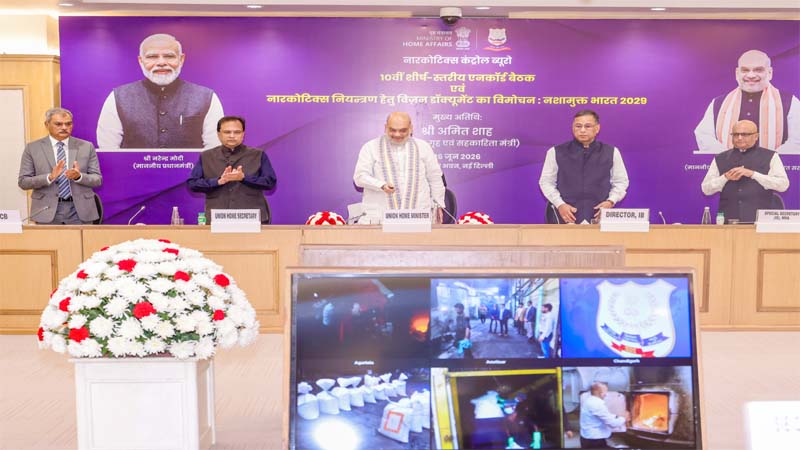
New Delhi: Union Home and Cooperation Minister Amit Shah on Friday said that the period from 2026 to 2029 will be the most decisive phase in India’s fight against narcotics. He asserted that the next three years will determine whether the country succeeds in defeating drug cartels and illegal narcotics networks or allows the menace to grow further.
Chairing the 10th Apex-Level Meeting of the Narcotics Coordination Centre (NCORD) at Vigyan Bhawan in New Delhi, Shah unveiled the National Drug Control Vision Document (2026–2029). The document outlines a comprehensive national roadmap based on three key pillars—Demand Reduction, Supply Reduction, and Harm Reduction—to effectively combat the drug menace across the country.
Zero-Tolerance Strategy Against Drugs
Addressing the gathering, Amit Shah reaffirmed the Government of India’s commitment to Prime Minister Narendra Modi’s “Zero Tolerance Against Drugs” policy. He stressed that tackling the drug problem requires coordinated efforts not only from law enforcement agencies but also from all ministries, state governments, and concerned institutions.
He said the government aims to dismantle drug trafficking networks through enhanced coordination between the Centre and states, the use of advanced technology, and stronger enforcement mechanisms during the 2026–2029 period.
Comprehensive Review at NCORD Meeting
The high-level NCORD meeting reviewed the current status of drug trafficking, substance abuse, and ongoing enforcement operations across the country. Senior officials from central ministries, state governments, law enforcement agencies, and other stakeholders participated in the discussions.
The meeting assessed the progress made so far and deliberated on strategies to strengthen India’s national response to narcotics over the next three years.
Key Features of the Vision Document
According to the Ministry of Home Affairs (MHA), the Vision Document has been prepared after extensive consultations with government departments, drug law enforcement agencies, and other stakeholders.
The roadmap focuses on:
- Reducing both the demand and supply of narcotic substances.
- Cracking down on synthetic drugs and darknet-based trafficking.
- Strengthening intelligence-driven, network-based enforcement.
- Launching large-scale awareness campaigns to prevent youth from falling into drug abuse.
- Expanding treatment and rehabilitation facilities for drug users.
- Enhancing coordination and information-sharing among enforcement agencies.
- Defining clear responsibilities, measurable targets, and time-bound implementation.
The ministry stated that the document integrates enforcement, rehabilitation, public awareness, capacity building, and inter-agency coordination into a unified national strategy for policy formulation and implementation.
NCB Annual Report and New Zonal Offices
During the event, Amit Shah is also scheduled to release the Narcotics Control Bureau (NCB) Annual Report 2025. In addition, he will inaugurate the newly established NCB Zonal Offices in Jammu and Guwahati, which are expected to strengthen anti-drug operations, particularly in border and strategically sensitive regions.
Major Step Towards a Drug-Free India
The government described the National Drug Control Vision Document (2026–2029) as more than just a policy framework, calling it a comprehensive action plan to achieve the goal of a “Drug-Free India.”
By promoting coordinated efforts among enforcement agencies, state governments, and all stakeholders, the roadmap seeks to dismantle illegal drug networks, protect India’s youth from substance abuse, curb organized crime, and build a healthier, safer, and more secure nation over the next three years.