Journalists’ Dialogue at Haryana Bhawan Raises Questions Over Press Freedom Amid ‘Godi Media’ vs ‘Pappu Media’ Debate
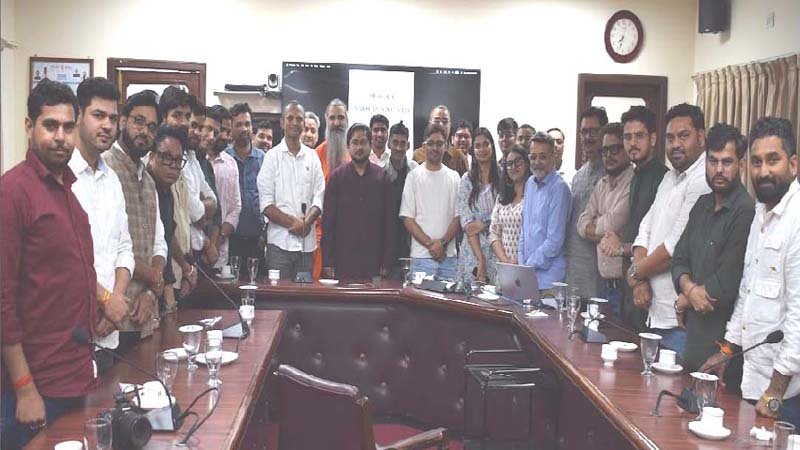
New Delhi: A dialogue among journalists was organised on Sunday at Haryana Bhawan, Copernicus Marg, New Delhi, under the joint aegis of Media Scan and Kala Premi Lekhak Sangh (KALES). Beginning at 4:30 pm, the discussion was held on the theme “The Wall of Labelling Between My Journalist and Your Journalist.” Journalists who covered the protest at Jantar Mantar from the ground shared their experiences, highlighting concerns over ideological labelling in the media, freedom of expression, professional safety and access to legal assistance during disputes or crises.
Debate Over ‘Godi Media’ and ‘Pappu Media’
During the discussion, several journalists alleged that reporters covering the Jantar Mantar protest were repeatedly labelled as “Godi Media.” They said journalists who asked questions that did not align with a particular ideological viewpoint faced criticism and objections, including in the press club setting.
Participants questioned whether journalists should be denied the opportunity to express their views simply because others disagree with their ideology or reporting approach. Some also spoke about the tense atmosphere at the protest site and what they described as a lack of adequate institutional or legal support for journalists facing difficult circumstances.
They argued that labels such as “Godi Media” and “Pappu Media” deepen divisions within the journalistic community. Despite ideological differences, they said, professional respect, freedom to ask questions and open dialogue must remain central to journalism.
Ground-Level Reporting Experiences Shared
Journalists also recounted their experiences while reporting from Connaught Place to Janpath. Some participants said the slogan “Godi Media” was repeatedly directed at certain reporters during the protest. When the counter-label “Pappu Media” was used, they said, the debate shifted towards journalistic ethics and professional solidarity.
Journalist Keshav observed that the protest was unusual in his experience because journalists themselves became involved in confrontations with fellow reporters. He said that, at times, the large presence of journalists at the protest site meant they were questioning one another rather than engaging with members of the public.
Participants also alleged that some media organisations portrayed the activities of independent YouTube journalists as those of an organised group. They emphasised that a journalist’s work should be assessed on the basis of reporting standards, facts and professional conduct rather than ideological identity alone.
Young Journalist Bhagya Shree Questions Press Club’s Role
Bhagya Shree, a young journalist associated with Pamphlet, said she had attended a protest for reporting purposes for the first time. She alleged that when she asked Ashutosh Ranka a question at the press club, an attempt was made to silence her by calling her “Godi Media.”
She questioned why a journalist asking a question should be categorised or dismissed rather than given an answer. Bhagya Shree said the Press Club of India should serve as a common platform for journalists across viewpoints instead of being perceived as an institution limited to people associated with a particular political party or ideology.
She added that if journalists’ rights were not protected and treatment depended on whether someone was considered an insider or an outsider, questions about the institution’s impartiality were inevitable.
Emphasis on Journalists’ Safety and Legal Assistance
The discussion, which lasted approximately two and a half hours, examined practical challenges faced by journalists during ground reporting. Some participants pointed out that when a First Information Report (FIR) is registered in another state or a legal dispute arises, journalists may find themselves fighting the case without adequate support.
Participants said such dialogues would be meaningful only if they led to practical solutions. Beyond holding meetings, they called for concrete initiatives to address journalists’ safety, access to legal assistance and the protection of independent reporting.
Media Scan emphasised the importance of continuing the conversation. Participants observed that identifying the underlying problems accurately could help pave the way for workable solutions.
Journalists and Media Professionals Participate
The discussion featured contributions from several journalists and media professionals, including Sushil Chaudhary of Khabar India, Rohit Atri of Khabar Panch, Abhishek Shandilya of Global Bharat TV, Chandrakesh of Political Adda, Chandan Kumar and Keshav Malan of OpIndia, and Ranu and Bhagya Shree of Pamphlet. Anupam Prasun and Nitish Thakur also contributed to the discussion.
The programme was held in the presence of senior journalist Anuranjan Jha; Akanksha Pare Kashiv of Outlook; social media influencer Pawan Vijay; writer Jalaj Anupam; Gaurav Kumar Mishra, editor of Policy Samvad; Brijesh Kumar, editor of Bharatiya Dharohar; Ajit Singh, editor of Chhatra Shakti; senior writer Keshav Patel; Jai Prakash from Lucknow; Subhash Chandra; and Acharya Vishalanand of Divya Jyoti Jagrati Sansthan.
Aditya Bhardwaj and Akshay Sharma played important roles in planning and executing the event.
The programme organised by Kala Premi Lekhak Sangh (KALES) received support from Media Scan, Delhi; Yogdaan Seva Trust, Noida, Uttar Pradesh; Grassroot Media Foundation, Jaipur; and Udgam Trust, Ahmedabad.
“Freedom of Expression Belongs to All Journalists and Citizens”
The concluding message of the programme was that journalists covering the Jantar Mantar protest should not be silenced. Freedom of expression, participants said, cannot be the exclusive preserve of any one ideological group or media organisation. It is a fundamental democratic concern protected by the Indian Constitution.
Questions were also raised about the role of the Press Club of India. Participants argued that, as a common platform for journalists, the institution should uphold impartiality, encourage dialogue and remain committed to protecting the rights of journalists across professional and ideological differences.
The broader message of the discussion was that journalism must make room for disagreement and ideological diversity. Journalists should be evaluated on the basis of their work, evidence and reporting rather than being placed into predetermined ideological categories.
The participants stressed that independent journalism, fair dialogue and professional safety are essential to a healthy democratic discourse.