
From Grandfather’s Strings to Raju’s Hands, Rajasthan’s Puppetry Lives On
Sonal Jain
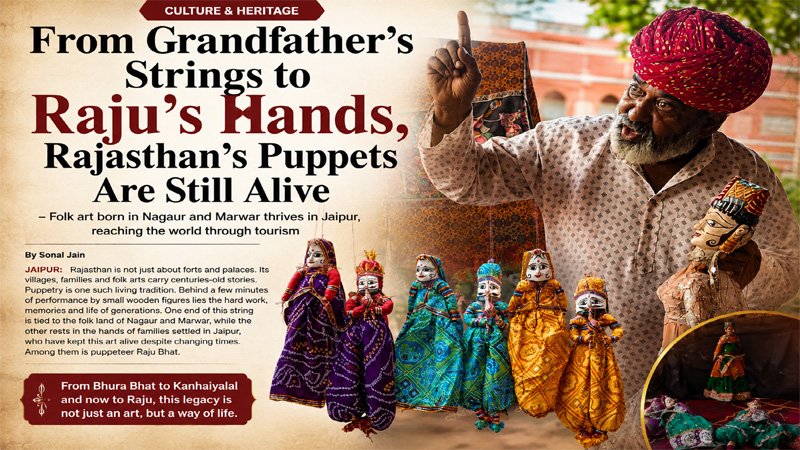
Jaipur: Rajasthan’s identity is not limited to its forts and palaces. Its villages, families and folk traditions carry stories passed down through generations. Traditional puppetry is one such art form. A puppet that moves on stage for a few minutes carries behind it the memories, hard work and lives of several generations.
One end of this string is rooted in the folk traditions of Nagaur and Marwar. The other is now in the hands of families settled in Jaipur who have kept the art alive despite changing times. Raju Bhat is one of these artists.
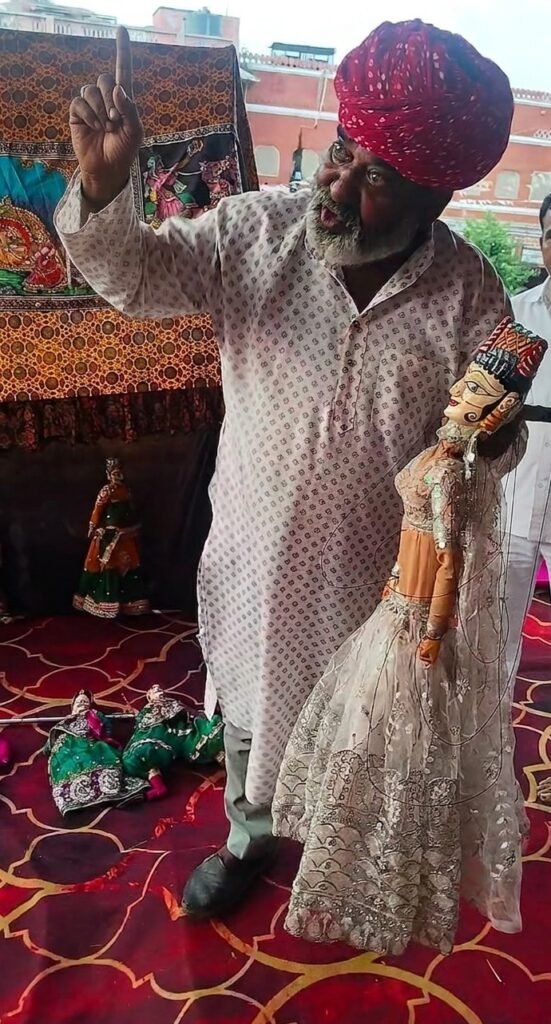
The moment a puppet comes into Raju’s hands, the wooden figure turns into a character. Its head bends, its hands move and its colourful costume comes alive. Raju says he did not learn the art from a book. It was handed down to him at home. His father, Kanhaiyalal Bhat, practised and preserved the tradition, while his grandfather, Bhura Bhat, was also associated with the art.
For Raju, therefore, puppetry is not merely a profession. It is a family legacy.
A String That Travelled from Nagaur
Rajasthan’s puppetry tradition has long been associated with Nagaur and the wider Marwar region. It developed alongside the Bhat community’s traditions of storytelling, genealogy and preserving collective memory, giving folk stories a visual and theatrical form.
For generations, puppeteers travelled from village to village. A village square, a fair, a family gathering or even a royal court could become their stage. Times changed, audiences changed and stories evolved, but the tradition of telling stories through puppets survived.
For Raju’s family, this journey also carries a special memory. According to the family, his grandfather Bhura Bhat once performed a puppet show before India’s first Prime Minister, Jawaharlal Nehru. The memory remains a matter of pride for the family.
From Grandfather to Father, and Father to Raju
The journey from Bhura Bhat to Kanhaiyalal and then to Raju is not just a story of an art form. It is also a story of livelihood and survival.
There was a time when puppetry was an important source of income for many artist families. Puppeteers travelled with their puppets and performance equipment, setting up a stage wherever they found an audience.
Over time, several families moved from Nagaur and Marwar to cities such as Jaipur. Their surroundings changed and their lives changed, but their identity remained intact.
Even today, puppets are made in their homes, costumes are prepared and children learn to handle the strings by watching the elders.
Raju’s family represents that transition—roots in Nagaur, a present in Jaipur and an eye on the future.
The Appeal Has Survived the Mobile Age
Entertainment today fits into the palm of the hand. Raju acknowledges that the world has changed, but believes puppetry still has the power to stop people in their tracks.
When the puppets take the stage, children are not the only ones who stop to watch. Adults too pause and become part of the performance.
The reason is simple. A story on a mobile screen is watched; in puppetry, the story appears to be born right in front of the audience.
The artist pulls a string, and at that very moment, the character comes alive.
That human element remains the art form’s greatest strength.
Society Is Changing, But the Connection Remains
For Raju, puppetry is also a way of staying connected with his roots.
He believes the younger generation must study, explore new employment opportunities and build better lives. But he also believes that moving forward should not mean forgetting where one comes from.
When the younger generation combines education and modern aspirations with an understanding of its traditional art, tradition does not become a burden. It becomes an identity.
Tourism Gives the Art a New Stage
Tourism has also given this traditional art a new opportunity.
Visitors to Rajasthan increasingly seek more than forts, palaces and monuments. They want to experience the state’s folk life, music, costumes and stories.
Puppetry becomes a living bridge between the visitor and Rajasthan’s cultural heritage.
Opportunities provided to folk artists through Rajasthan Tourism events and tourism platforms have helped take the art to new audiences.
For artists like Raju, these platforms are more than performance opportunities. They provide a way to take the art inherited from their fathers and grandfathers to a new generation of audiences.
When a foreign visitor watches a puppet show in Jaipur, they are not simply watching a wooden puppet move on strings. They are witnessing a small part of a folk tradition that travelled from Nagaur and Marwar and survived because families like Raju’s made it part of their lives.
Know the Puppet Tradition
What is Kathputli?
Kathputli is Rajasthan’s traditional string-operated folk puppetry. The name is commonly explained through kath (wood) and putli (puppet/doll).
How old is the tradition?
There is no universally accepted historical date for the origin of Rajasthan’s puppetry tradition. Rajasthan Tourism presents it as a tradition dating back around 1,500 years and associates its possible origins with the Nagaur region. It is therefore more appropriate to describe it as an ancient folk theatre tradition passed down through generations rather than assign it a definitive starting date.
Why is it associated with Nagaur?
Rajasthan Tourism and other cultural sources associate Nagaur and surrounding areas with the development of the state’s puppetry tradition. The art has also been linked with the Bhat community’s traditions of storytelling, genealogy and collective memory.
How are puppets made?
Traditionally, the head is carved from wood and painted. The body is made from cloth and filling material and dressed in traditional attire. Strings attached to the puppet are used by the performer to control its movements.
Who operates the puppets?
The puppeteer controls the strings with the hands and fingers while coordinating movement with dialogue, music and storytelling.
What is the connection with the Bhat community?
The Bhat community has traditionally been associated with storytelling, genealogy and preserving family histories. Puppetry provided a visual and theatrical medium for presenting such stories and folk legends.
What stories are traditionally performed?
Rajasthani puppetry has featured stories of folk heroes and historical figures, along with social and entertaining episodes. The legend of Amar Singh Rathore is among the well-known examples.
Why does puppetry matter today?
Puppetry is no longer merely a form of folk entertainment. It is part of Rajasthan’s cultural identity and tourism experience. Tourism platforms provide artists with new audiences and livelihood opportunities, helping keep the tradition alive.
And perhaps that is the real story behind Raju’s strings: a small wooden puppet moves on stage, but behind every movement lies a much larger story of Rajasthan—of family, memory, migration and a tradition that refuses to disappear.