
‘This Is the Path of Mahavir, Where Every Living Being Is a Saint’: Mahavir Nirvan Katha Resonates at Bharat Mandapam
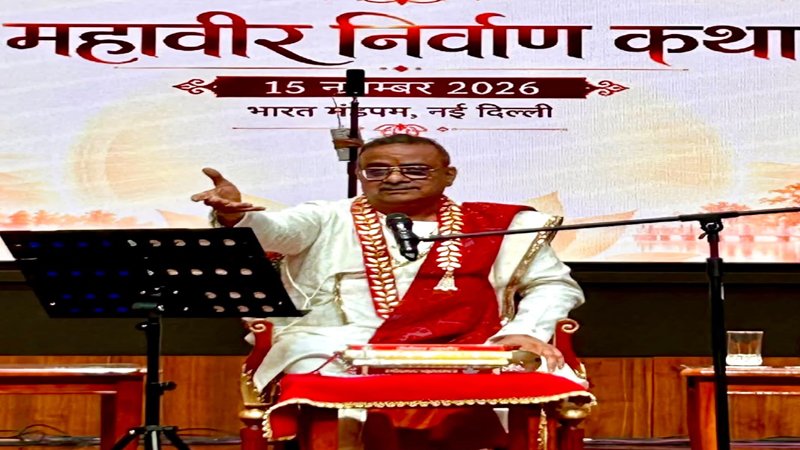
Musical narration by CA Rajiv Jain brings the story of Pavapuri to life; the message of non-violence amid the horrors of war culminates in a grand celebration illuminated by thousands of lamps
New Delhi: The presentation of ‘Mahavir Nirvan Katha – Mere Mahavir 3.1’ was held at Bharat Mandapam on Sunday, jointly organised by Bhagwan Mahavir Deshna Foundation and BRJ Productions. Through his narration, original music and visual presentation, renowned chartered accountant CA Rajiv Jain brought alive the story of Pavapuri, dating back nearly 2,552 years, and the final chapter of Bhagwan Mahavir’s life. The audience was visibly moved by several episodes of the presentation.
Acharya Lokesh Muni, founder of Ahimsa Vishwa Bharati, Sant Adarsh Muni and Kishor Makwana, Chairperson of the National Commission for Scheduled Castes, were among the distinguished guests who attended the event and watched the entire presentation. Their presence reflected a shared commitment to taking Bhagwan Mahavir’s message of non-violence and compassion to a wider section of society.
The venue offered glimpses of ancient Pavapuri and significant episodes from Bhagwan Mahavir’s life. Guests were welcomed with saffron tilak and presented with lamps for the Deepotsav. Following the invocation, LED screens depicted Bhagwan Mahavir’s final Chaturmas and the Samavasaran at Pavapuri. Nominated Municipal Councillor Manoj Kumar Jain portrayed King Hastipal, while Sudhir Jain played King Nandivardhan. Their dialogues took the audience through Mahavir’s birth, childhood, youth, renunciation and initiation.
Bhagwan Mahavir’s ideas of equality, freedom and the right of every living being to exist were also explained in the context of modern values enshrined in Articles 14, 19 and 21 of the Indian Constitution. His twelve-and-a-half years of rigorous spiritual practice, silence, non-violence and journey towards omniscience were portrayed through music and visuals. The central message, “This is the path of Mahavir, where every living being is a saint,” underlined the potential of every soul to attain spiritual growth and ultimately reach the supreme state.
The episode of Chandanbala emerged as one of the most poignant moments of the narration. The war between King Shatanik of Vatsa, whose capital was Kaushambi, and King Dadhivahan of Champa, along with the devastation it caused and its impact on innocent people, was depicted through powerful visuals. Chandanbala’s suffering raised a deeply relevant question: why must innocent people bear the consequences of the lust for power, accumulation and violence? Connecting the episode with wars and conflicts taking place across the world today, the presentation highlighted the continuing relevance of Mahavir’s principles of non-violence and non-possession. The scene in which Bhagwan Mahavir accepted food from Chandanbala after five months and twenty-five days was particularly moving for the audience.
The dialogue between Bhagwan Mahavir and King Shrenik, historically known as Bimbisara, offered an engaging explanation of the Jain principles of karma, the state of infernal existence and the belief that Shrenik would become a Tirthankara in the future. The narration then returned to Pavapuri, where Bhagwan Mahavir’s final sermon covered subjects such as the living and non-living, the law of karma, food, purification of the soul, freedom from attachment and the path to liberation, using simple examples.
Explaining the four states of existence—celestial beings, humans, animals and infernal beings—the presentation discussed the joys, sorrows and circumstances associated with each, while emphasising the value of human birth. According to Jain philosophy, human life is precious because it offers an opportunity to exercise discernment, penance, restraint and purposeful effort to prevent the bondage of new karmas, shed accumulated karmas and move towards liberation. The narration conveyed that one should understand the purpose of existence while still alive rather than wait for death to arrive.
The audience was also deeply touched by the portrayal of Gautam Swami’s journey of introspection and his attainment of omniscience following Bhagwan Mahavir’s Nirvana.
The narration was creatively linked through dialogues by Abhisha Jain, the programme’s anchor and creative director. Original compositions by music director Pradeep Jain gave the presentation its musical character. The programme concluded with a Nirvan song, a Deepotsav featuring thousands of lamps and the aarti of Bhagwan Mahavir, creating a deeply devotional atmosphere.
The event was telecast live through television and YouTube channels, reaching audiences in India and abroad. The presentation highlighted the Jain principles of non-violence, Anekantavada, equality, non-possession and environmental protection, along with messages of vegetarianism, ethical conduct and an addiction-free life. Emphasising sensitivity towards earth, water, fire, air, vegetation and every living being, it conveyed that non-violence is not merely the act of refraining from killing, but a commitment to respecting the existence of every life form and practising restraint in everyday life.
The successful organisation of the event was made possible through the special contributions of Bhagwan Mahavir Deshna Foundation’s Director Subhash Oswal Jain, Manoj Jain, CA Rajiv Jain and CA Anil Kumar Jain; Honorary Host Satyabhushan Jain; Regional Director Manish Jain; and Christy Jain and Shubham Jain.
From BRJ Productions, its founder and producer Beena Jain, co-producer Varshu Jain and Advocate Manibhadra Jain played key roles in bringing the presentation to life. Arun R. D. Jain, Ravi Jain, Naresh Anand Prakash Jain, Ashok Jain, Vipul Jain, CA Navita Jain, Shruti Jain and Ashok Jajwan also extended special support to the event.