
BHU holds high-level review meeting to assess preparations for Kashi Tamil Sangamam 5.0
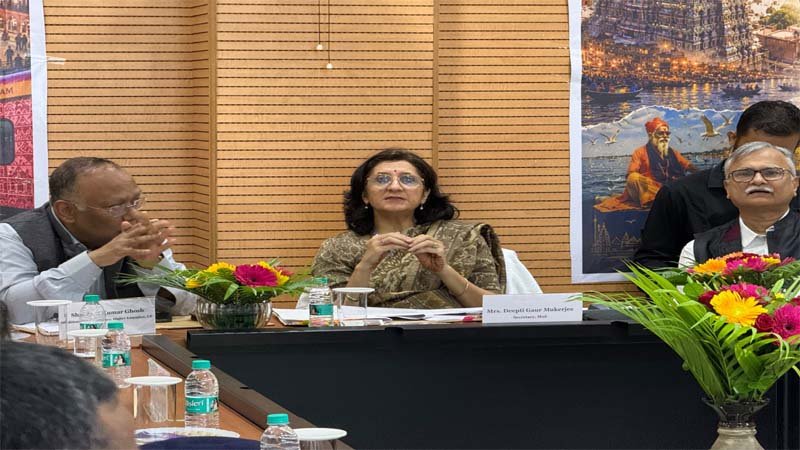
Varanasi (UP): Kashi Tamil Sangamam 5.0 will be held from November 28 to December 12, 2026, with the objective of strengthening the centuries-old cultural and civilisational ties between Kashi and Tamil Nadu. The theme for this edition is ‘Thirukkural Payilvom’, meaning ‘Let us learn Thirukkural’. A high-level review meeting was held at Banaras Hindu University (BHU) on Tuesday to assess preparations for the event. Officials from various departments participated in the meeting.
The meeting was attended by Ms Deepti Gaur Mukherjee, Secretary, Department of Higher Education, Government of India; Prof. Ajit Kumar Chaturvedi, Vice-Chancellor, BHU; Mr Amit Kumar Ghosh, Principal Secretary, Higher Education, Government of Uttar Pradesh; Ms Ankita Mishra Bundela, Additional Secretary, Ministry of Education; and Mr Chamu Krishna Shastry, Chairman, Bharatiya Bhasha Samiti. The Divisional Commissioner of Varanasi and officials from the district administration, police administration and various departments were also present.
The meeting reviewed preparations, inter-departmental coordination, logistical arrangements and other key aspects to ensure the smooth and successful conduct of the event.
Thirukkural to connect languages and cultures across India
The fifth edition of Kashi Tamil Sangamam will focus on Thirukkural, the timeless literary work of saint-poet Thiruvalluvar. Comprising 1,330 couplets, the text offers profound insights into Dharma, Artha and Kama, along with teachings on ethics, righteous conduct and values of life. Recognising its universal relevance, the Central Institute of Classical Tamil has facilitated its translation into all 22 languages included in the Eighth Schedule of the Constitution.
This edition will place special emphasis on taking the timeless teachings of Thirukkural to young people and educational institutions across the country.
Students from 1,000 institutions across India to participate
Under the programme, students from 1,000 participating institutions will study Thirukkural. These institutions will be selected through nodal institutions across different states and Union Territories. Each participating institution will assess interested students and select one candidate on merit.
The selected students will attend two academic lectures in their respective languages and participate in a month-long research and academic engagement programme. Under the guidance of a faculty supervisor or mentor, each student will prepare a four-to-five-page article or research note. In addition, every participant will deliver a one-hour presentation to communicate the message of Thirukkural to their respective institution and campus.
Portal and registration process already launched
The web portal and registration process for Kashi Tamil Sangamam 5.0 were launched by Union Education Minister Mr Pralhad Joshi on October 22, 2026. The Ministry of Education will play a key role in implementing the programme.
The Central Institute of Classical Tamil, Chennai, will oversee the event portal, registration, selection process, multilingual academic orientation, digital archive, mobile application, films, publications and outreach to schools. IIT Madras and Banaras Hindu University will serve as the respective nodal and coordinating institutions for Tamil Nadu and Kashi.
Indian Railways, Airports Authority of India, National Highways Authority of India, the Ministry of Culture and the governments of Uttar Pradesh and Tamil Nadu will also extend support in promoting the event and facilitating travel, exhibitions and other arrangements.
Strengthening the spirit of ‘Ek Bharat Shreshtha Bharat’
Kashi Tamil Sangamam was conceived to advance the vision of ‘Ek Bharat Shreshtha Bharat’. The event serves as an important platform to connect the younger generation with the historical, cultural, linguistic, spiritual and academic links between the ancient city of Kashi on the banks of the Ganga and Tamil civilisation, which developed along the banks of the Vaigai and Cauvery rivers.