BRICS Tourism Meeting Gives Rajasthan a New Global Platform, Jaipur Emerges as a Hub for Tourism Dialogue
Jaipur: The BRICS Tourism Ministers’ Meeting provided Jaipur with an important global platform to showcase Rajasthan’s rich heritage, culture, hospitality and investment potential. The Jaipur Declaration was unanimously adopted during the meeting, while BRICS delegates visited iconic heritage sites including the Hawa Mahal, City Palace and Amber Palace. The UAE-Rajasthan Tourism and Investment Round Table also explored opportunities for investment in the tourism sector.
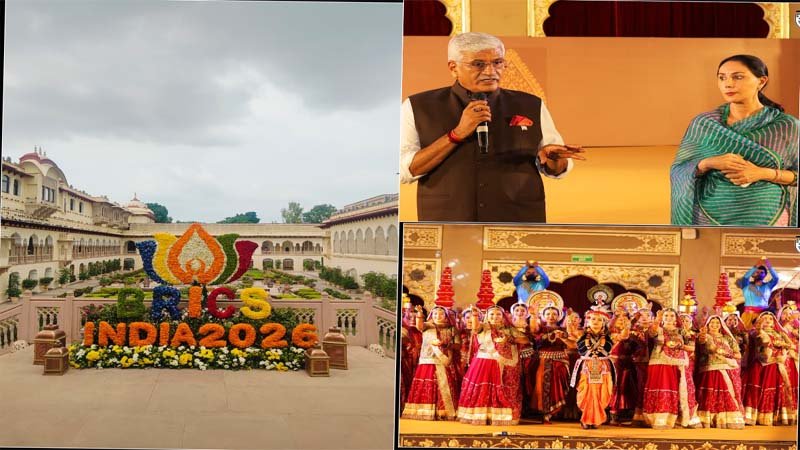
A cultural evening at Rambagh Palace added another dimension to the event, with around 100 artists presenting ‘Megharang – The Colours of Sawan’, bringing India’s classical and folk traditions together on one stage. The event further positioned Jaipur as an important centre for global dialogue on tourism, culture and investment.
Focus on Linking Tourism with Development and Sustainability
The Jaipur event reflected India’s broader approach to its BRICS chairship, which seeks to connect tourism with economic development, culture and sustainable growth.
Prime Minister Narendra Modi has emphasised people-centric development, sustainable lifestyles, afforestation, the circular economy and community-based adaptation in the context of India’s BRICS chairship. In tourism, this vision was reflected through discussions around resilience, innovation, cooperation and sustainable development.
Meetings of the BRICS Tourism Working Group focused on several key areas, including AI and tourism, sustainable and responsible tourism, tourism skills and capacity building, tourism exchanges and seamless travel facilitation.
The Jaipur Declaration identified responsible and human-centric AI, destination management, visitor services, multilingual communication, tourism investment, conservation of natural and cultural heritage, and community-centric tourism as key areas for cooperation.
Heritage Sites Offer Delegates a Glimpse of Rajasthan
A visit to Jaipur’s iconic heritage sites was an important part of the programme for BRICS delegates. They visited the Hawa Mahal, City Palace and Amber Palace, experiencing Rajasthan’s architectural heritage, history and cultural traditions first-hand.
The visits offered delegates an opportunity to experience Rajasthan beyond conference rooms and official discussions. The architecture of its palaces, artistic traditions and vibrant culture presented a vivid picture of the state’s immense tourism potential.
Connecting Tourism with Investment Opportunities
The UAE-Rajasthan Tourism and Investment Round Table, held at Rambagh Palace, provided a platform to connect tourism with investment opportunities.
Chief Minister Bhajan Lal Sharma invited UAE companies to explore investments in Rajasthan in sectors including energy, hospitality and other areas. Highlighting the state’s forts, palaces, havelis, deserts, wildlife sanctuaries, gems and jewellery, handicrafts and textiles as key strengths, he assured investors of all possible support.
UAE Minister of Economy and Tourism Abdulla bin Touq Al Marri expressed interest among UAE companies in Rajasthan’s hospitality sector. He also indicated a desire to further strengthen air connectivity between Jaipur and Dubai and invited Chief Minister Bhajan Lal Sharma to visit Dubai.
From the Jaipur Declaration to a Celebration of Culture
While the Jaipur Declaration outlined a broader framework for tourism cooperation among BRICS nations, the cultural evening connected the international gathering with Rajasthan and India’s diverse cultural heritage.
Delegates were also offered curated experiences showcasing traditional arts, crafts and community-based tourism initiatives. The ‘Megharang – The Colours of Sawan’ presentation at Rambagh Palace showcased the richness of India’s classical and folk traditions.
The programme featured classical dance forms such as Kathak, Bharatanatyam, Odissi and Manipuri, alongside Rajasthan’s Ghoomar, Kalbelia, Bhavai, Chari and Gair. Puppetry, Chhau, Dhol and Cholom performances further enriched the cultural showcase.
The 40-minute presentation brought together nearly 100 artists, offering a glimpse of India’s diverse cultural traditions on a single stage.
Jaipur Strengthens Its Position on the Global Tourism Map
The BRICS Tourism Meeting showcased Jaipur not merely as a historic and cultural destination, but also as an important platform for tourism policy, investment, technology, sustainable development and international cooperation.
From the Jaipur Declaration and heritage visits to investment discussions and cultural performances, the entire event highlighted Rajasthan’s diverse strengths. The gathering has provided the state’s tourism sector with an opportunity to explore new global possibilities, attract investment and strengthen international partnerships.