
KTS 5.0: Thirukkural’s Timeless Message of Ethics, Good Governance and Human Values Continues to Guide the World
Praveen Kumar Jha
India’s civilisation lives not only in its ancient temples, historical monuments and religious traditions, but also in its rich intellectual heritage and timeless ideas that have shown humanity the path towards a better life. The Thirukkural, composed by the great Tamil saint-poet Thiruvalluvar, is one such timeless masterpiece. Transcending the boundaries of time, language and geography, it conveys universal messages of ethics, righteousness, justice and responsible living.
Rooted in a Tamil literary tradition dating back nearly two thousand years, the Thirukkural is not merely a cultural treasure of South India or India; it is a shared intellectual heritage of humanity. Its 1,330 concise couplets contain profound truths about life that remain as relevant to modern society, politics and global governance as they must have been at the time of their composition.
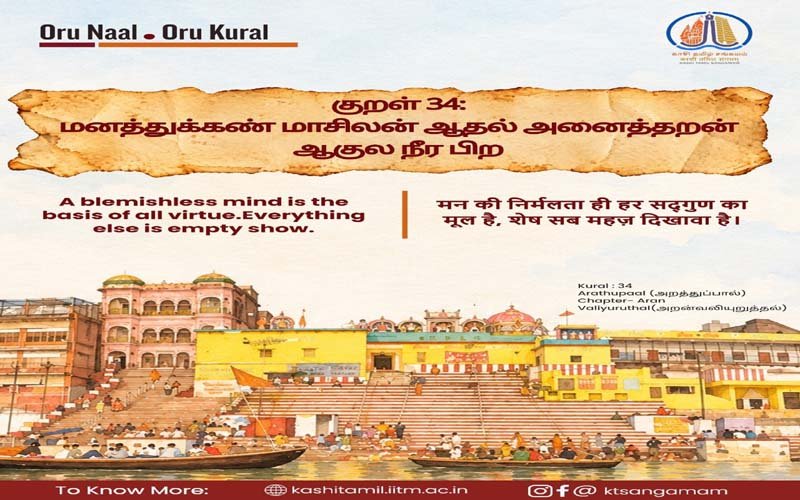
What makes the Thirukkural unique is that it does not treat knowledge as merely an academic subject. Instead, it connects wisdom with everyday conduct, social relationships and the ethics of governance. This is why it is regarded as one of the greatest works of Tamil literature and has been translated into numerous languages across the world. Even its title reflects its distinctive character. ‘Thiru’ signifies respect and sacredness, while ‘Kural’ refers to a short poetic form. In remarkably few words, Thiruvalluvar expressed profound insights into human experience and universal moral principles.
The central theme of the fifth edition of Kashi Tamil Sangamam (KTS 5.0) is the Thirukkural. On October 22, 2026, Union Education Minister Shri Pralhad Joshi launched the registration portal for the fifth Kashi Tamil Sangamam, scheduled to be held from November 28 to December 12, 2026.
The event will celebrate, revive and strengthen the centuries-old civilisational connections between Tamil Nadu and Kashi, two ancient centres of learning, while reinforcing the spirit of ‘Ek Bharat Shreshtha Bharat’. Addressing the occasion, Shri Pralhad Joshi said that India has enjoyed a strong cultural unity since ancient times. He observed that people have traditionally undertaken pilgrimages to Kashi and Rameswaram as part of their religious practices, reflecting the deep cultural bonds between the northern and southern parts of the country.
The programme will bring together students, teachers, writers, professionals, farmers, artists, women and spiritual scholars. The Union Minister also announced that educational awareness programmes would be organised in higher education institutions to familiarise students with the objectives of Kashi Tamil Sangamam. He reiterated that the initiative has played an important role in strengthening national unity and celebrating India’s shared civilisational heritage.
The Thirukkural is divided into three major sections—Aram, Porul and Inbam. Together, these sections present a comprehensive picture of the personal, social and emotional dimensions of human life.
The first section, Aram, deals with virtue and righteous conduct. It explores values such as honesty, non-violence, compassion, self-control, gratitude and altruism. According to Thiruvalluvar, true religion is not reflected merely in external rituals or religious formalities; it is manifested in a person’s conduct and inner purity.
Showing kindness towards others, avoiding deceit, speaking the truth and remaining sensitive towards all living beings form the foundation of an ethical life. These ideals continue to inspire human sensitivity and social harmony in contemporary society.
The second section, Porul, deals with governance, administration, economics, leadership, diplomacy and social life. It offers practical insights into the qualities of an ideal ruler, the competence of ministers, justice, security, friendship and the responsibilities of statecraft.
In Thiruvalluvar’s vision, an ideal state is one where people are protected from hunger, disease and insecurity. The responsibility of a ruler is not limited to exercising power; it is to ensure public welfare, justice and social stability.
This is why the Porul section remains relevant even in the context of modern democratic governance, public policy and political leadership.
The third section, Inbam, also known as Kamattuppal, presents a poetic exploration of love, marital relationships, family life and human emotions. It reflects the broad vision of Indian thought, which recognises the importance of worldly experiences and emotional relationships alongside spiritual and ethical pursuits.
In this way, the Thirukkural encompasses every major dimension of human existence—from individual character and family life to society and the state.
Today, the world is facing numerous challenges. Wars, political instability, economic inequality, social divisions and international mistrust have made the global order increasingly complex. In such circumstances, the Thirukkural’s emphasis on just governance, responsible leadership, ethical conduct and social welfare assumes special significance.
The text reminds us that the true meaning of power lies not merely in strength, but in its responsible exercise. The success of leadership should not be measured solely by achievements; it must also be judged by how far its decisions make the lives of ordinary citizens safer, more dignified and better.
When India presents its intellectual heritage on global platforms, works such as the Thirukkural add depth to its cultural diplomacy. They represent a tradition that gives importance to dialogue, ethics, coexistence and human welfare.
While the Thirukkural represents India’s intangible intellectual heritage, the Ramanathaswamy Temple in Rameswaram, Tamil Nadu, stands as a living example of Indian architecture, religious faith and cultural continuity.
Rameswaram is one of India’s most important pilgrimage destinations and occupies a special place in the Char Dham tradition. Dedicated to Lord Shiva, the Ramanathaswamy Temple is also counted among the twelve Jyotirlingas.
Indian religious tradition recognises a special spiritual relationship between Kashi and Rameswaram. The practice of carrying Ganga water from Kashi to Rameswaram to perform the abhishekam of Lord Shiva symbolises this cultural unity. It demonstrates how pilgrimages, faith and cultural connections have historically brought India’s vast geographical diversity together.
According to popular mythological beliefs, after defeating Ravana, Lord Rama resolved to establish a Shiva Lingam on the seashore and worship Lord Shiva. It is believed that when Hanuman was delayed in bringing a Shiva Lingam from Mount Kailash, Mata Sita fashioned one out of sand, which Lord Rama worshipped. This came to be known as Ramalingam. Later, the Shiva Lingam brought by Hanuman was also installed. This legend is regarded as a symbol of the harmony between Shaivite and Vaishnavite traditions and the inclusive character of Indian culture.
The Ramanathaswamy Temple is an outstanding example of Dravidian architecture. Its construction and expansion took place over several centuries under the patronage of different rulers and dynasties.
The temple’s expansive corridors, ornate pillars and intricate carvings reflect the extraordinary craftsmanship of Indian artisans. Its long pillared corridors and 22 sacred wells are among its most distinctive features. The architecture is not merely a symbol of religious faith; it also demonstrates India’s ancient technical knowledge, artistic vision and architectural excellence.
Presenting such cultural symbols on global platforms is an important way of connecting India’s contemporary identity with its ancient roots. India is rapidly advancing in science, technology, economics and strategic capabilities, but its global identity is also shaped by thousands of years of civilisation, philosophy, literature and art.
Presenting a timeless work such as the Thirukkural in Russian at international forums like BRICS is an important example of India’s cultural diplomacy. Such initiatives provide an opportunity to take India’s knowledge traditions to diverse linguistic and cultural communities across the world.
The presentation of the Thirukkural in Russian is not merely a literary translation; it is a medium for the exchange of ideas between India and the world. Through this effort, India shares an intellectual heritage that embodies universal values such as ethics, good governance, humanity and social responsibility.
Similarly, showcasing architectural landmarks such as the Ramanathaswamy Temple at the international level helps bring India’s tangible cultural heritage greater global recognition.
The strength of India’s cultural diplomacy lies in this synthesis: on the one hand, the ethical philosophy of Thiruvalluvar; on the other, the magnificent architectural tradition of Rameswaram; and alongside them, the scientific, economic and technological achievements of modern India.
The Thirukkural and the Ramanathaswamy Temple are distinct yet complementary symbols of India’s civilisational continuity. One provides ethical direction to human life, while the other keeps alive the country’s magnificent traditions of art, faith and architecture.
Presenting these treasures on global platforms is not merely an exercise in celebrating the past; it is also a way of sharing India’s vision for the future. It conveys the message that modern development and ancient wisdom are not in conflict with each other; rather, they are foundations that enrich one another.
The timeless teachings of the Thirukkural continue to remind us that the true greatness of a nation lies not merely in its power and prosperity, but in its ethical values, human sensitivity and responsibility towards society.
This is the essence of India’s civilisational identity—a nation that draws inspiration from its ancient intellectual heritage, engages in dialogue with the modern world and presents its cultural legacy as a contribution towards building a shared future for humanity.

