Arunachal Pradesh Cabinet Celebrates PM Modi’s 25 Years of Continuous Service as Head of Government
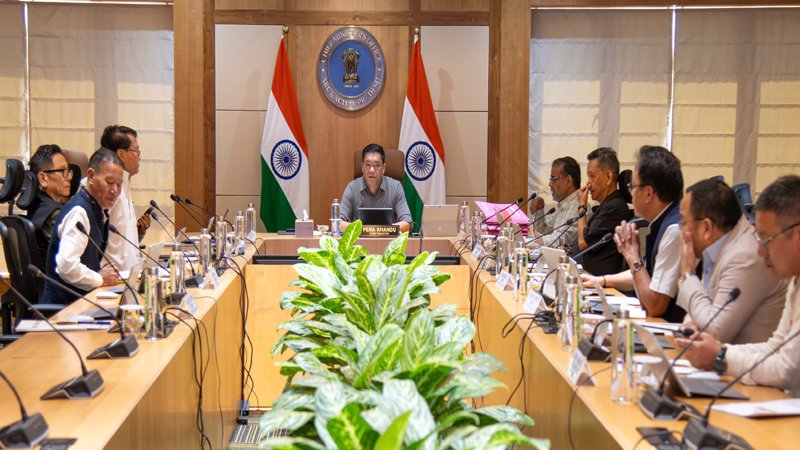
Itanagar (Arunachal Pradesh) : The Arunachal Pradesh Cabinet, led by Chief Minister Pema Khandu, has congratulated Prime Minister Narendra Modi on completing 25 years of continuous service as Head of Government on October 7, 2026, acknowledging his contribution to India’s development and reaffirming the state’s commitment to the vision of a Viksit Bharat by 2047.
Modi took oath as Chief Minister of Gujarat on October 7, 2001, and went on to become Prime Minister of India on May 26, 2014. His third consecutive term as Prime Minister began on June 9, 2024, reflecting continued public confidence in his leadership, the Cabinet noted.
The Cabinet observed that while his responsibilities have expanded from grassroots work to leading a state and the country, his dedication to the nation has remained unwavering. Guided by the principle of “Seva Hi Samarpan” and his description of himself as the “Pradhan Sevak”, Modi has placed public service at the centre of governance. His approach, the Cabinet said, has been shaped by the mantra of “Sabka Saath, Sabka Vikas, Sabka Vishwas and Sabka Prayas”.
Cabinet Highlights Major National Reforms
The Cabinet highlighted the transformation India has witnessed under Modi’s leadership across welfare, economic development, national security, technology, infrastructure and cultural heritage. It cited key initiatives and reforms, including the abrogation of Article 370, the replacement of colonial-era criminal laws with the Bharatiya Nyaya Sanhita, the introduction of the Goods and Services Tax (GST), and the next-generation GST 2.0 reforms.
The Cabinet also expressed gratitude to the Prime Minister for launching the next-generation GST 2.0 reforms and the GST Bachat Utsav during his visit to Itanagar on September 22, 2025, the first day of Navratri. It noted that the Cabinet resolution had been adopted on October 11, the first day of Navratri in 2026.
Arunachal Pradesh’s Progress in Welfare and Basic Services
The Cabinet stated that Arunachal Pradesh has been an active partner in the country’s development journey. The state has achieved 100% coverage under the Pradhan Mantri Garib Kalyan Anna Yojana, benefiting more than 8.57 lakh people.
Around 55,000 families have received permanent houses registered in women’s names, while 2.28 lakh households have been provided with functional tap-water connections. Arunachal Pradesh became the first state in the Northeast to achieve 100% saturation under the Jal Jeevan Mission, according to the Cabinet.
More than 2.26 lakh families are covered under Ayushman Bharat–Pradhan Mantri Jan Arogya Yojana (AB PM-JAY) and the Chief Minister’s Arogya Arunachal Yojana (CMAAY), providing cashless healthcare coverage of up to ₹5 lakh per family annually.
Focus on Farmers, Women and Youth
The Cabinet said the Prime Minister’s focus on Annadata, Nari Shakti and Yuva Shakti has strengthened livelihoods and created new opportunities across the state.
More than 1.14 lakh farmers in Arunachal Pradesh have been enrolled under PM-KISAN, with over ₹150 crore transferred directly to their bank accounts.
Nearly one lakh women have been mobilised into 15,999 Self-Help Groups (SHGs). More than 16,000 women have become Lakhpati Didis, while another 36,000 have been identified to achieve the same goal.
In education and sports, 50 government schools have been upgraded into Golden Jubilee Model Schools, while 58 Khelo India Centres are operating across every district. The state has also supported 156 startups with seed funding exceeding ₹5.59 crore, with women leading 45.5% of these ventures.
Infrastructure and Border Development Gain Momentum
The Cabinet noted significant improvements in connectivity and strategic infrastructure. The Sela and Nechiphu tunnels have strengthened all-weather connectivity, enhanced strategic mobility and supported tourism.
Donyi Polo Airport, the state’s first greenfield airport, has an annual passenger-handling capacity of one million. Tezu Airport has also been upgraded with a new terminal building.
Under Phase I of the Vibrant Villages Programme, 455 villages across 11 districts were selected. Roads covering 1,022 km, with an approved cost of ₹2,205 crore, are planned to connect 126 border villages. Another 122 villages along the Myanmar and Bhutan borders have been included under Phase II.
The Cabinet said these initiatives are helping integrate frontier communities into the development process while strengthening border infrastructure and national security.
Hydropower to Strengthen Arunachal’s Economic Potential
The Cabinet described Arunachal Pradesh as an emerging centre of renewable energy development. The 2,000 MW Subansiri Lower Hydroelectric Project has been developed at a cost of ₹30,071 crore, with four units commissioned and the remaining units expected to become operational shortly.
Investments exceeding ₹52,000 crore have also been approved for five additional hydropower projects. Together, these projects are expected to generate nearly 4,000 MW of renewable energy and contribute to India’s clean-energy and net-zero ambitions.
Indigenous Heritage and Buddhist Tourism
The Cabinet expressed gratitude to the Union Government for supporting the recognition, preservation and promotion of Arunachal Pradesh’s indigenous, tribal and Buddhist heritage, cultures and traditions.
Twenty indigenous products from the state have received Geographical Indication (GI) tags. The Union Budget for 2026–27 has also announced a scheme to develop Buddhist circuits in six Northeastern states, including Arunachal Pradesh.
Meanwhile, rare manuscripts and medical manuscripts are being documented and digitised under the Gyan Bharatam Mission. Under the Special Assistance to States for Capital Investment, ₹4,900 crore has been allocated to Arunachal Pradesh under the Pride of Hills component.
The Cabinet renewed its commitment to building on these achievements and strengthening the foundation for a developed India by 2047. It extended its congratulations to Prime Minister Modi and reaffirmed the state’s resolve to work under his guidance towards a prosperous, secure, self-reliant and developed India.
Cabinet Approves Recruitment Reforms in Technical Education
Apart from the resolution commemorating the Prime Minister’s 25 years of public service, the Cabinet approved several decisions aimed at strengthening higher and technical education, improving healthcare services, supporting women in distress and streamlining administrative arrangements.
The Cabinet approved uniform, merit-based recruitment rules for 12 categories of posts in government engineering and polytechnic colleges, in accordance with the applicable All India Council for Technical Education (AICTE) Regulations, 2019.
The approved rules cover Principals in government polytechnic and engineering colleges; Assistant Professors, Associate Professors and Professors in government engineering colleges; Workshop Superintendents, Assistant Librarians, Laboratory Assistants, Senior Technical Assistants and System Analysts in engineering colleges; and Heads of Department for Civil Engineering in government polytechnic colleges.
The rules are intended to establish a transparent and uniform recruitment mechanism in line with the AICTE Diploma and Degree Regulations, 2019.
20 Posts Approved for Women’s Helpline-181
To strengthen support for women facing distress and emergencies, the Cabinet approved the creation of 20 posts for the operation of the Women Helpline-181 scheme under the Mission Shakti guidelines.
Women Helpline-181 is a toll-free, round-the-clock service designed to provide emergency assistance and connect women in distress with medical services, shelter, legal aid, emotional support and other forms of assistance.
Educational Institutions Renamed in Honour of Local Contributors
The Cabinet approved the renaming of Government College, Seppa, in East Kameng district, as Donglo Sonam Government College, Wessang, in honour of late Donglo Sonam, recognised for his contribution to the development of East Kameng district and Arunachal Pradesh.
It also approved renaming Government Higher Secondary School, Daporijo, as Lt. Punji Mara Government Higher Secondary School, Daporijo, and Government Model Degree College, Daporijo, as Popak Bage Government Model Degree College, Reempu Yorlo.
Healthcare Workforce to Receive Additional Support
The Cabinet approved an enhancement in grade pay for various categories of posts under the National Leprosy Elimination Programme (NLEP) in the Department of Health and Family Welfare. The move is intended to address concerns over wage parity, improve staff morale and productivity, and strengthen patient care and rehabilitation services.
In another healthcare-related decision, the Cabinet approved the creation of five posts of Food Safety Officer, Group B, Gazetted Non-Ministerial. The additional positions are expected to address staffing gaps in the state’s food-law enforcement system and strengthen food-safety monitoring and enforcement to protect public health.