
BSPS 13th Foundation Day: Discussion on Digital Journalism, Emphasis on the Need for a Media Council
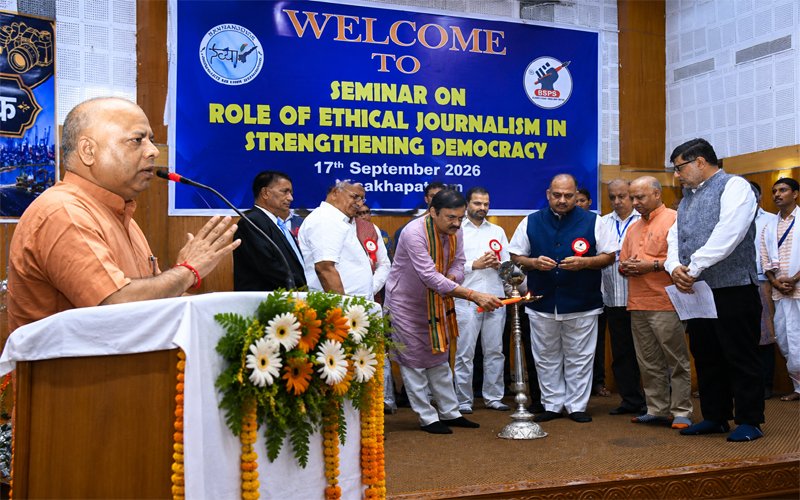
Visakhapatnam: The digital revolution has significantly expanded opportunities for expression, but it has also created new challenges concerning the credibility, accuracy, ethics and accountability of journalism. The availability of cameras and microphones to everyone does not automatically make a person a professional journalist. Journalism, at its core, is about facts, truth, impartiality and responsibility towards society and the public interest.
These views were expressed by senior journalist and keynote speaker Krishnamohan Jha at the 13th Foundation Day समारोह of the Bhartiya Shramjeevi Patrakar Sangh (BSPS) held in Visakhapatnam. Organised under the aegis of the Navyandhra Journalists Welfare Association, the event witnessed detailed discussions on the growing influence of digital media, ethical journalism, journalists’ welfare and the changing media landscape.
The invited Chief Guest, the Home Minister, could not attend the programme due to unavoidable circumstances. However, other invited guests, representatives of journalist organisations and members were present, and various speakers shared their views on the challenges facing journalism and the role of journalists.
Need to Distinguish Social Media Influencers from Professional Journalists
Speaking on the theme “Ethical Journalism in a Democratic System,” Krishnamohan Jha said digital media has significantly expanded both the reach and scope of journalism. Today, anyone can launch a digital platform and communicate news and views to society. While this represents an important expansion of freedom of expression, it has also raised questions about the identity, credibility and accountability of journalism.
He noted that people carrying cameras and microphones can now be seen collecting news in many areas and often identifying themselves as journalists. However, a basic understanding of journalism, verification of facts, reliability of sources and the responsibility to present all sides of a story are not necessarily reflected equally in every case.
Jha raised the question of what mechanism should determine accountability for irresponsible activities carried out in the name of journalism and who should oversee such practices.
He stressed the need to clearly distinguish between social media influencers and professional journalists. According to him, the number of followers, popularity or activity on social media should not be treated as professional criteria for journalism.
He said the credibility of journalism should instead be assessed on the basis of how facts are verified, how reliable the sources are, whether the views of relevant parties are presented, whether errors are corrected and how much importance is given to public interest throughout the process.
Call for Consideration of a Comprehensive Media Council
Jha also discussed the existing regulatory framework in the changing media environment. He said systems developed during the era of traditional media are facing new challenges due to the rapid expansion of digital media, social media and emerging content platforms.
He called upon the government to consider the formation of a comprehensive Media Council in view of changing technological and media conditions. He clarified that the objective of such a mechanism should not be to restrict freedom of journalism or expression, but to strengthen professional standards, ethics and accountability in journalism.
He said, “My question is not about restricting anyone’s freedom of expression. My question is about protecting the credibility of journalism.”
Focus on Journalists’ Welfare and Security
The senior journalist also highlighted the issue of journalists’ welfare. He said society expects journalists to practise fearless, impartial and honest journalism, but greater institutional attention is also required towards their social and economic security.
He emphasised that strengthening journalism cannot be achieved merely by expecting journalists to maintain ethical standards and responsibility. Institutional efforts are equally necessary to ensure the dignity, safety and welfare of journalists.
He urged journalist organisations to continue working not only for the welfare of journalists but also for strengthening the quality, credibility and professional standards of journalism.
Freedom Must Go Hand in Hand with Accountability
In his concluding remarks, Krishnamohan Jha said independent journalism plays an important role in a democracy, but freedom does not mean freedom from responsibility. Independent and accountable journalism, he said, are complementary rather than contradictory.
He said a journalist’s primary responsibility is towards society. Giving priority to facts and public interest while remaining above the influence of the government, opposition, institutions or any other interest should remain at the heart of journalism.
Other speakers and representatives of journalist organisations present at the event also shared their views on the changing nature of journalism, journalists’ welfare, organisational unity, professional responsibilities and the challenges facing the media landscape.
The 13th Foundation Day समारोह of BSPS provided a platform for discussion on journalist unity and welfare, as well as the credibility, ethics and social accountability of journalism in the digital age.